In the late 19th century, American and British aristocrats popularised Dinard as a fashionable summer resort, for Fran and Conal a visit to the resort was a Must Do.
By Conal Healy
October 28, 2023 (9am): Day Three in St Malo: Travelling France in autumn can be risky. The weather isn’t always the best – the days are slowly getting shorter and the cooler weather is usually the order of the day.
As comedian Billy Connelly said: “There is no such thing as bad weather … just poor clothing choices.”
When Fran and I woke in St Malo that Saturday morning, the forecast for the day suggested “Clear skies in the morning, rain in the afternoon”.
On our list of Things To Do in St Malo were two places we wanted to visit – Dinard (by the sea) and Dinan (on the river). Both were close by, but you needed a car to get there.
In the late 19th century, American and British aristocrats popularised Dinard as a fashionable summer resort, constructing impressive villas on the cliff tops and exclusive hotels such as Le Grand Hotel on the seafront during the French “Belle Epoque”.
Dinard experienced significant growth during this period. From the 1850s, affluent families were captivated by the area and commissioned the construction of luxury villas. Today, with a casino, art galleries, and beautiful hotels, “Dinard, the elegant” remains a highly sought-after seaside resort.
Dinard’s reputation as the “Cannes of the North” has attracted various celebrities. Joan Collins frequently visits, and Winston Churchill enjoyed holidays on the River Rance.
T.E. Lawrence (Lawrence of Arabia) resided in Dinard as a young child, long before his renowned Arabian adventures, and Picasso painted here in the 1920s.
It is believed that Debussy conceived the idea for “La Mer” during a visit to Saint-Énogat in 1902. In 1996, Éric Rohmer filmed parts of Conte d’été in Dinard. Oscar Wilde also visited the town and mentions it in his work De Profundis.

Dinard is referred to as the ‘Nice of the north’, a luxurious retreat for the wealthy, evident from some of the magnificent mansions perched on the cliffs. One of these residences bears a striking resemblance to the house featured in Alfred Hitchcock’s film Psycho. Notably, there is a statue of Alfred Hitchcock by the beach, standing on an egg with a couple of birds on his shoulders.
Dinard is a vibrant and picturesque locale, characterized by its traditional Breton seaside charm, white sandy beaches, and emerald waters. There are rumors suggesting that Alfred Hitchcock, who spent time here, was inspired by one of these villas when designing the house for Psycho.
Fran and I arrived into a sleepy Dinard early on Saturday morning. Once again, we were in the Hire Car of Anxiety. Again, I was an alert for any possible traffic trouble. You can imagine my reaction as I drove down a main street when I was overtaken by man on an electric skateboard who disliked that I driving slowly – and waves his arms at me as he flew past.
I was stoic – at least I had got passed my “French Person Annoyed at my Driving” encounter for the day … and survived.
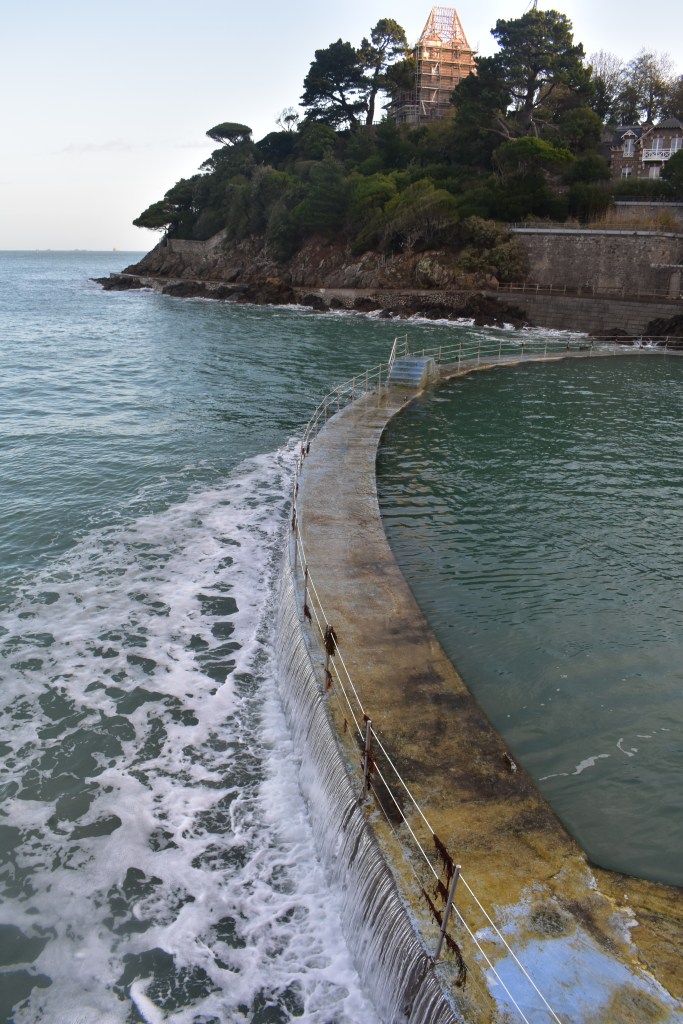
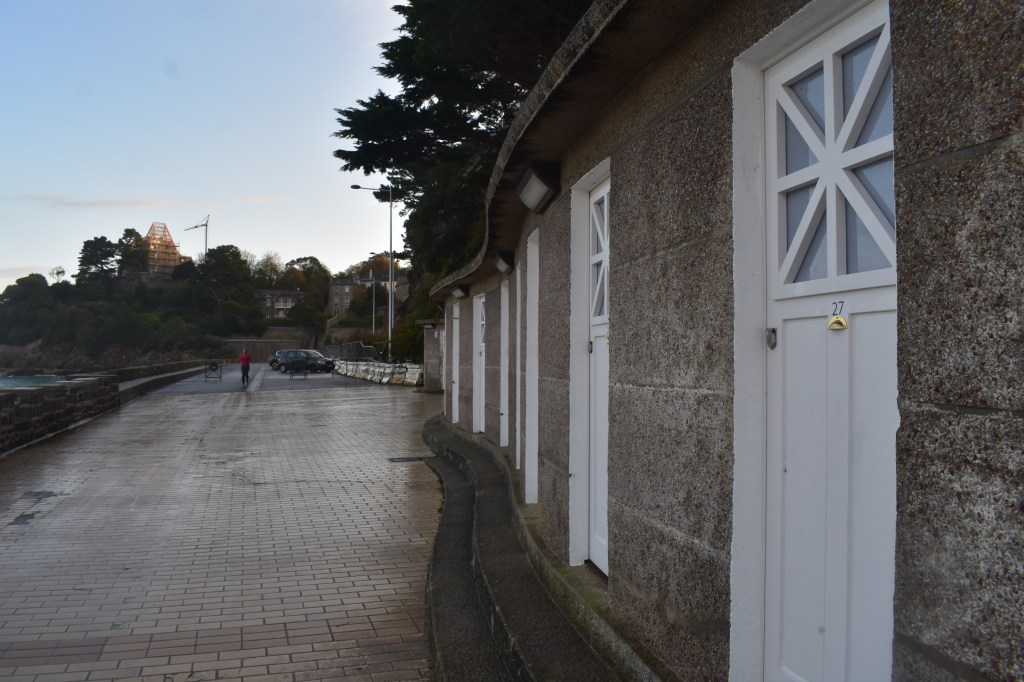
With nothing open, Fran and I walked down to the sea front (past the Alfred Hitchcock statue) for a walk along the promenade. The day was fine – blue skies with occasional clouds dotted to the horizon.
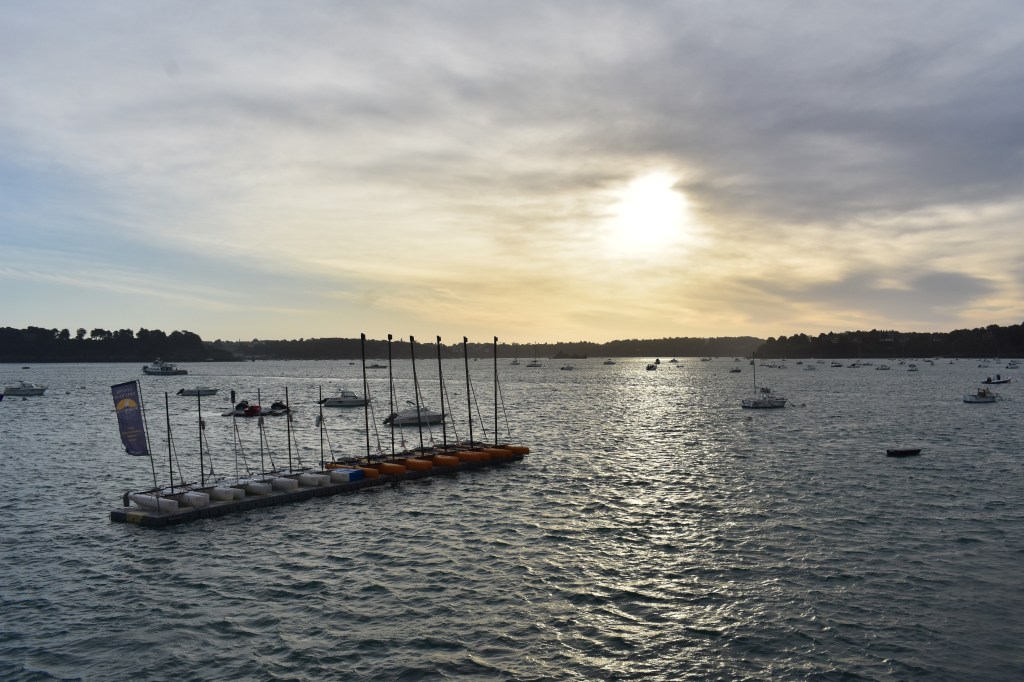
The lack of big waves meant we walked without fear of getting wet. People on the way to work, went past. From the headlands we saw Mt Malo on the other side of the bay and at the Pointe du Moulinet we marveled at the Cote d’Emeraude.
The Côte d’Émeraude (literally Emerald Coast) is a name given to a part of the English Channel coast of eastern Brittany near the border with Normandy.
Islands stretching into the distance seemed to suggest that to the French every large piece of protruding from the sea was perfect for the construction of a fort.
It should be noted that France and England, just on the other side of the English Channel have a series of conflicts from 1109 to 1815. In total, France won 24 of the wars, England/Britain won 11, and 6 were tied. For the French, the channel is called La Manche, (the sleeve).
We walked along the promenade wondering what it was like to stroll along here on a warm summer evening, the sound of laughter coming from the adjacent bars, listening to the waves lapping against the sea wall.
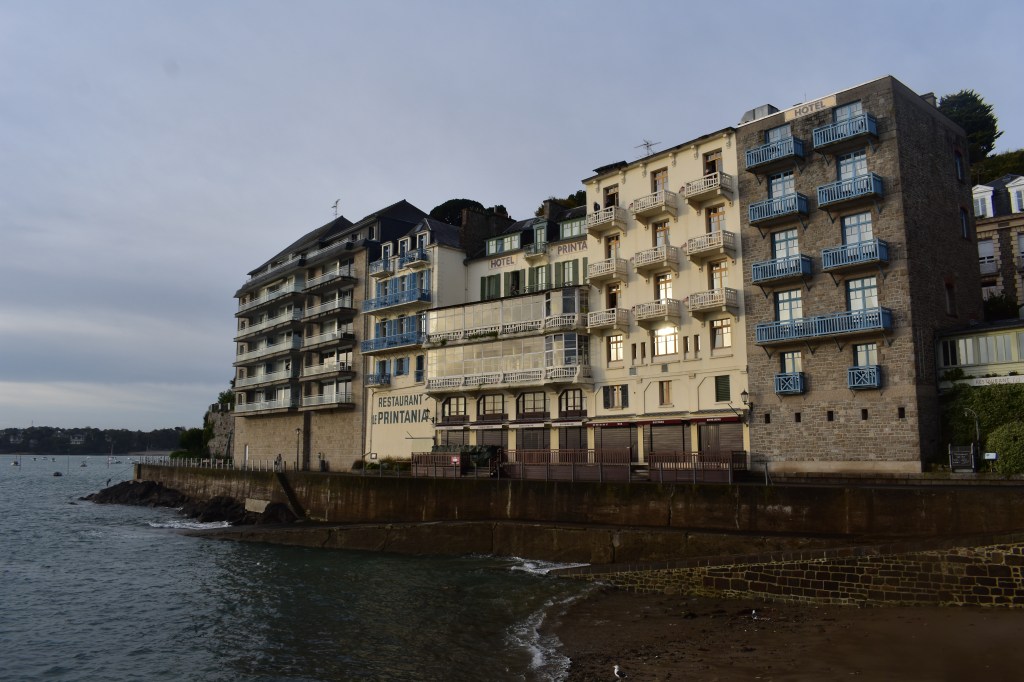
It was a pleasant stroll – past hotels that harked back to a more genteel time, probably when people “dressed for dinner”.
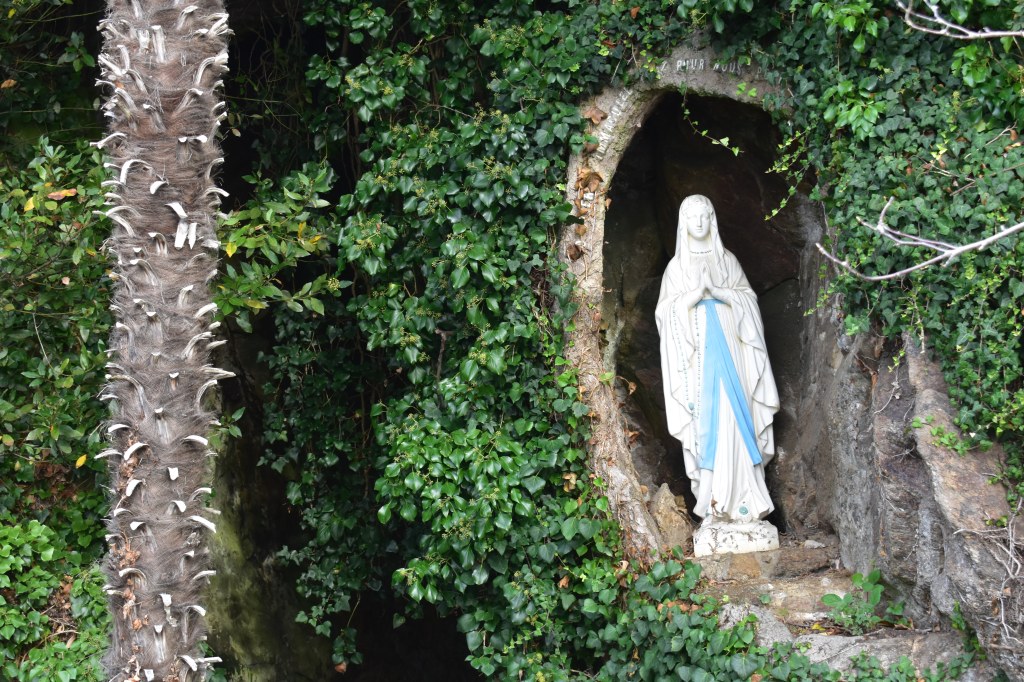
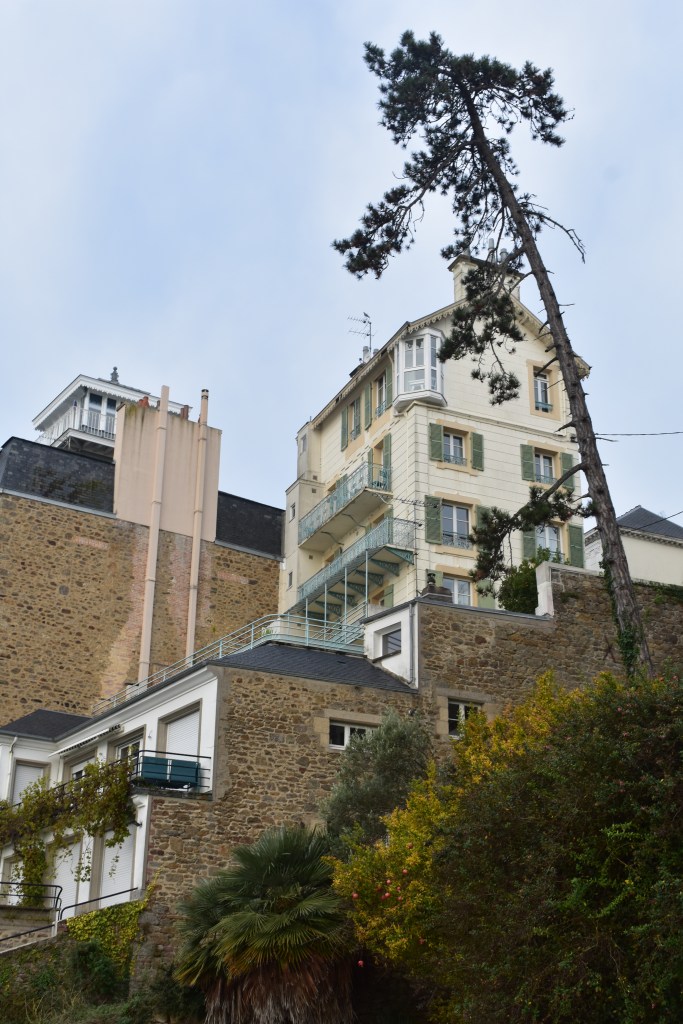
We passed a few Jehovah Witness followers with their usual pamphlets, spotted a Marian Shrine dedicated to sailors who had been lost to the sea, and glimpsed what have been Belle Epoche mansions perched high about the path to get a better view – with private pathways down to the beach. Is this how the upper classes lived?
It was late October in Dinard, but there were brave souls in the shallows doing aqua-exercises. By now thin clouds had covered the sun, the call for a morning coffee needed to be answered.
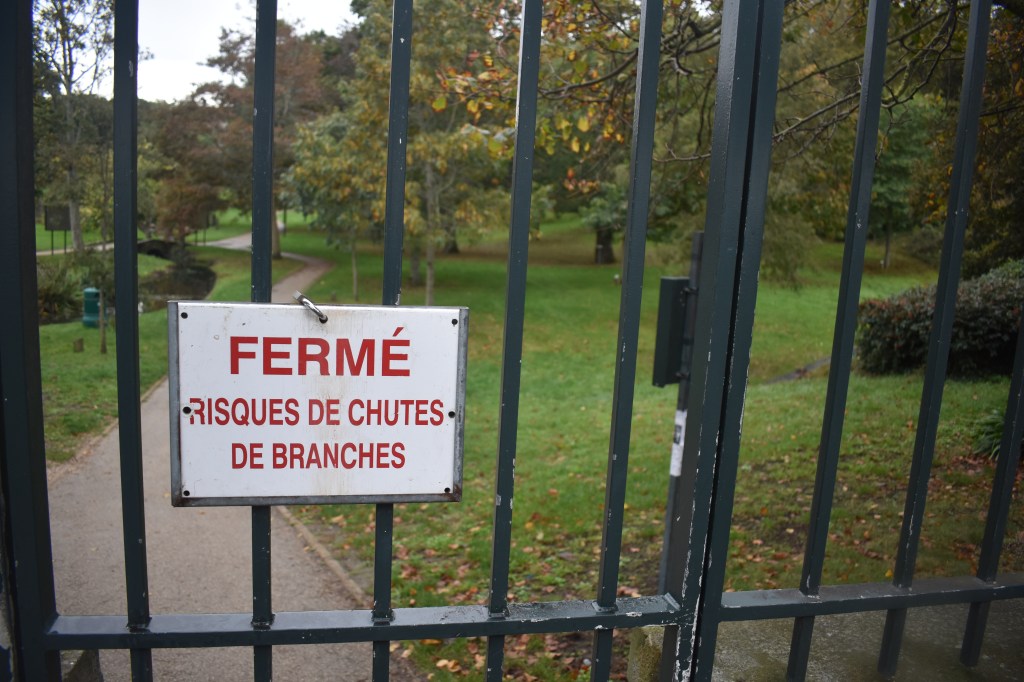
(A Google Maps shortcut through a local park was foiled when we discovered the attractive park was shut because of the danger from falling branches – “Ferme. Risques de chutes de branches”.)
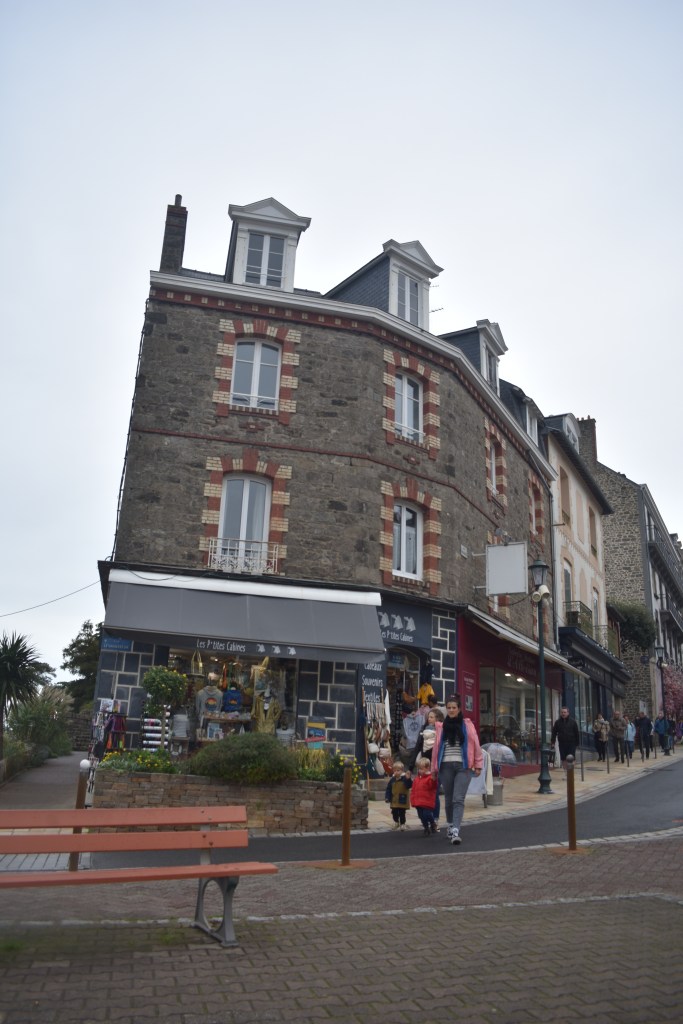
Dinard on a Saturday morning was busy. Local were at the markets, queues were forming outside boulangeries and traffic was building in the cramped town centre.
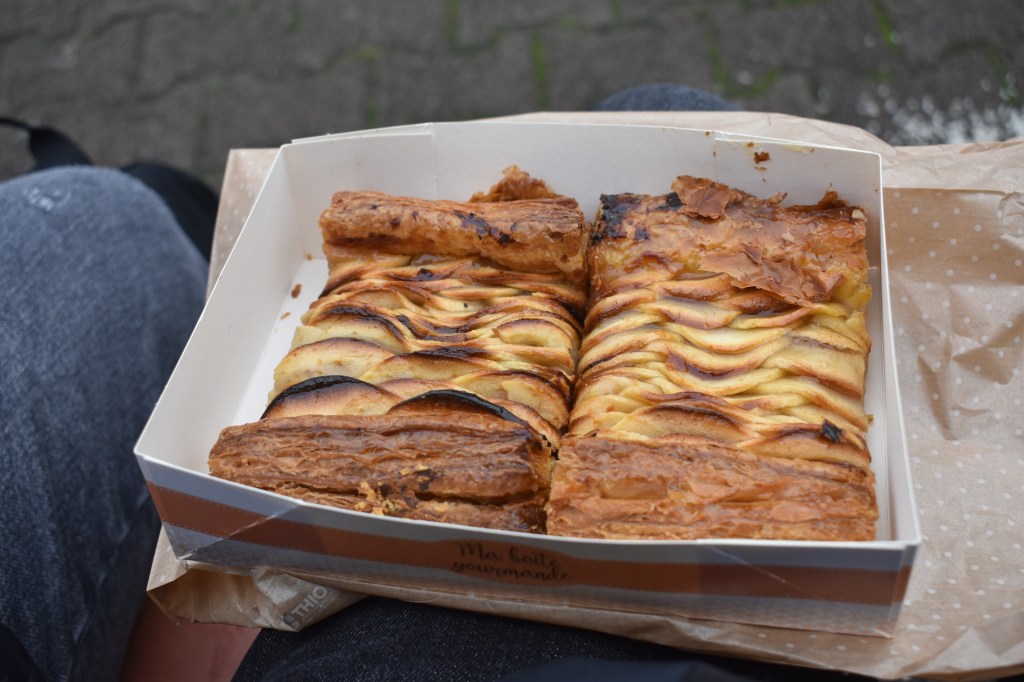
It was shortly afterwards that we broke one of the sacred rules of France. Unable to find a coffee shop with a sit-down option, Fran and I joined a queue and got some sweet treats for morning tea. With our coffee and pastries in hand, Fran and I found a street bench and began to enjoy the delicious treat.
Slowly we became aware that passerbys were looking (and scowling) at us. One middle-aged couple wished us a “Bon Appetite”.
I replied with a cheery “Merci”, oblivious to the fact that eating in the street in France is frowned on. Eventually we realized our faux pas, put the pastries back in the bag, dusted away the pastry flakes and icing sugar …. And slinked back to the hire car feeling suitably chastised.
We left Dinard feeling we had missed something – maybe a late, romantic dinner on a summers evening and then join the promenade of people along the seafront and then wander into a local bar for a nightcap.
Sadly, the weather had put us in a timetable.

Getting there
The French village of Dinard is located very close to Saint-Malo, about 12 kilometers (around 7.5 miles) apart by road. The journey between Saint-Malo and Dinard typically takes about 25 to 30 minutes by car depending on traffic.
There are several transport options between them:
Car or Taxi: About 29 minutes drive on roads connecting the two towns.
Bus: Regular bus services take around 18 to 20 minutes, with tickets costing approximately €2 to €4.
Ferry: There is also an hourly ferry crossing taking about 10 minutes, costing roughly €9.
Rideshare: Available routes take about 45 to 48 minutes on average based on available rideshare timings.
Walking or Cycling: It’s possible to walk or cycle the route; walking takes about an hour, and cycling is quicker but longer distance routes can vary.




 on the road less travelled in Ireland and france
Leave a comment