A traffic accident has shaken the confidence of Fran and Conal as they continued to explore north-west France. Could they go ahead with a planned visit to the iconic landmark, Mt St Michelle in nearby Normandy?
By Conal Healy
October 27, 2023: Second full day in St Malo, Brittany. The weather forecast said the day would be 16-11d, clear skies and then cloudy. This was the day we had planned to visit Mt St Michelle in nearby Normandy.
The previous day Fran and I discussed the events of the drive from Rouen. The two tyres blowing out in traffic had shaken both of us – the hire car was now a place that generated anxiety for us. In us.
Fran was now anxious about driving in France, this meant that I might have to do a lot of the driving if we continued. Do we really want to do another three weeks of traffic torture? As already mentioned, we could decide to stay in St Malo for the rest of the holiday? Could we cut our losses and return the car? Maybe go back to the safety of Paris, by train?
For decades I had wanted to visit Mt St Michel – a medieval island with a monastery in the sky off the coast of Normandy. It was about 50kms away from St Malo. If we wanted to see it we could book a tour (cost $1000), or get back into the hire car and drive there.
I decided to embrace my fear and do it anyway – it would be back in the car for the visit to the UNESCO World Heritage Site.
My return to Car of Anxiety didn’t start well. At the traffic lights, at bottom of the street, I stopped for a red light and mistakenly moved into a space meant for bikes and scooters.
It shouldn’t have been a big deal, except at that particular moment a large, local council garbage truck driver decided to take the sharp turn into the street … and found me in the space needed to make the turn, but now couldn’t.
He was stuck. I was stuck.
I was now a metre away from the a very large garbage truck. And I froze.
The anxiety, stress and fear from the blown-tyre incident erupted in my body … I couldn’t think.
There was no way out. I didn’t panic, I froze.
The garbage truck driver wound down his window and started shouting in French at me. Obviously he was making helpful suggestions to me … which I failed to understand.
Then the driver of the car behind me hit his horn. I looked into the rear view mirror and saw him gesticulating at me. And he was angry. Very angry.
In that moment, I pulled myself together. I realized there was a gap ahead, I just needed to reverse slightly and do a full lock of the steering wheel and squeeze past the truck.
I did that. The garbage truck eased past the Vitara, the angry man behind me overtook me, at speed.
The incident probably only lasted 90 seconds … but it added another layer of anxiety and stress to my feeling about the car.
Rattled, I drove on to Mt St Michel. How much more of this French driving could I cope with?
The good thing was the run to Mt St Michel was a fairly straight forward 54km drive (about 45 minutes) along a major road. That reduced some of my anxiety.
Fran and I were on the road just after sunrise, probably around 9pm, under a clear, blue, see-forever sky.
The guide books suggested getting there early, to beat the crowds. Another consideration was the tides. At various times of the day and night, Mt St Michel is cut off by by the sea.
Mont-Saint-Michel is a tidal island. The island lies approximately one kilometre off France’s north-western coast, at the mouth of the Couesnon River near Avranches and is seven hectares in area.
Now a rocky tidal island, the mount occupied dry land in prehistoric times. As sea levels rose, erosion reshaped the coastal landscape, and several outcrops of granite emerged in the bay, having resisted the wear and tear of the ocean better than the surrounding rocks.
The mount has a circumference of about 960 m (3,150 ft) and its highest point is 92 m (302 ft) above sea level.
The commune’s position — on an island just a few hundred metres from land — made it accessible at low tide to the many pilgrims to its abbey, and defensible as the incoming tide stranded, drove off, or drowned would-be assailants.
The island remained unconquered during the Hundred Years’ War. A small garrison fended off a full attack by the English in 1433.
Its popularity and prestige as a centre of pilgrimage waned with the Reformation, and by the time of the French Revolution there were scarcely any monks in residence.
The abbey was closed and converted into a prison, initially to hold clerical opponents of the republican regime. High-profile political prisoners followed.
By 1836, influential figures — including Victor Hugo — had launched a campaign to restore what was seen as a national architectural treasure. The prison was closed in 1863.
During the occupation of France in World War II, German soldiers occupied Mont-Saint-Michel, where they used St Aubert church as a lookout post. The island was a major attraction for German tourists and soldiers, with around 325,000 German tourists from July 18, 1940, to the end of the occupation of France.
After the Allies’ initial D-Day invasion of Normandy that began on June 6, 1944, many exhausted German soldiers retreated to strongholds like Mont-Saint-Michel.
On August 1, 1944, a single American soldier – Private Freeman Brougher of Pennsylvania and the 72nd Publicity Service Battalion – reached and liberated Mont-Saint-Michel accompanied by two British reporters, Gault MacGowan of the New York Sun and Paul Holt with the London Daily Express.
Jubilant crowds of locals greeted Brougher, Holt and MacGowan, and Brougher signed the Golden Book, the island’s record of visiting nobility, at the mayor’s invitation.
The abbey was also used as a prison for the first time since the French Revolution when male collaborators with the Germans were jailed there.
Mont-Saint-Michel and its surrounding bay were inscribed on the UNESCO list of World Heritage Sites in 1979 for its unique aesthetic and importance as a Catholic site.
It is visited by more than three million people each year, and is the most-visited tourist attraction in France outside of Paris. Over 60 buildings within the commune are protected as historical monuments.
In 2023, President Macron marked 1,000 years of the abbey, and the success of the hydraulic dam project and the elevated pedestrian bridge in restoring water flow in the bay, making the mount an island again.

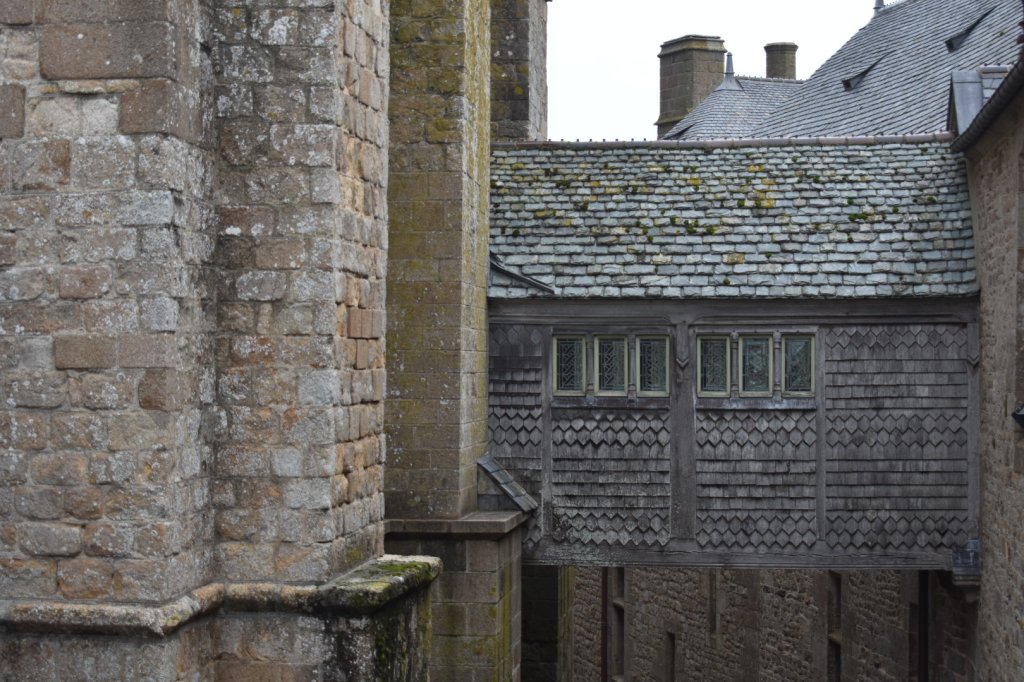
The drive to Mont-Saint-Michel was uneventful (after we left St Malo) – I double and triple checked for any dangers when we approached a junction.
As said previously: “I feel I am putting Fran’s life (and mine) in danger every time I step into it (the hire car). As I drive more, it is becoming less stressful. For the first few days of driving the palms of my hands would turn bright pink, from holding the steering wheel too tightly”.
We knew that food would be expensive on the island – it would be a trapped audience – so we stopped at a boulangerie close to Mont-Saint-Michel and Fran bought some fromage and gambon baguettes and other tasty treats for a lunchtime picnic, or as the French would say “pique-nique”.
Because it was early we found a car park quite easily. While entry to the island is free of charge, there is a fee to use the car park. I think we paid about 18 Euros.
As we lined-up to board the free shuttle bus we could see Mont-Saint-Michel perched on a rock in the distance.
One blogger described the sight: “Despite the flatness of the landscape, there is a rugged spirit to this region that is difficult to describe. About half an hour before arrival, the island’s silhouette emerged from the horizon like a giant iceberg. No matter how many pictures I had seen of Mont-Saint-Michel online, I was still mesmerized by the sight”.
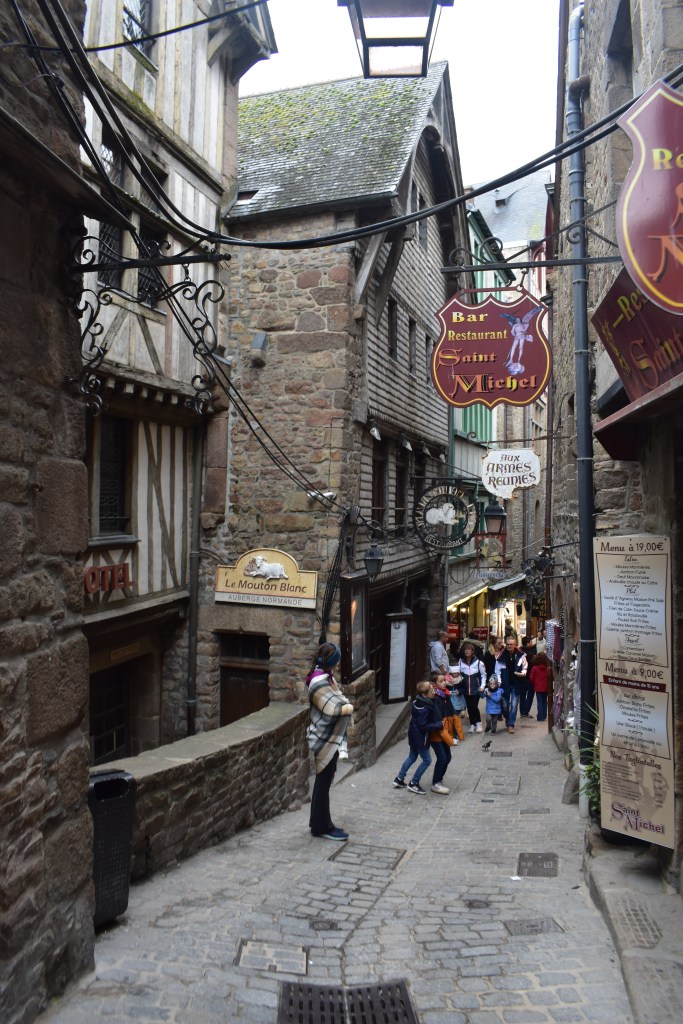
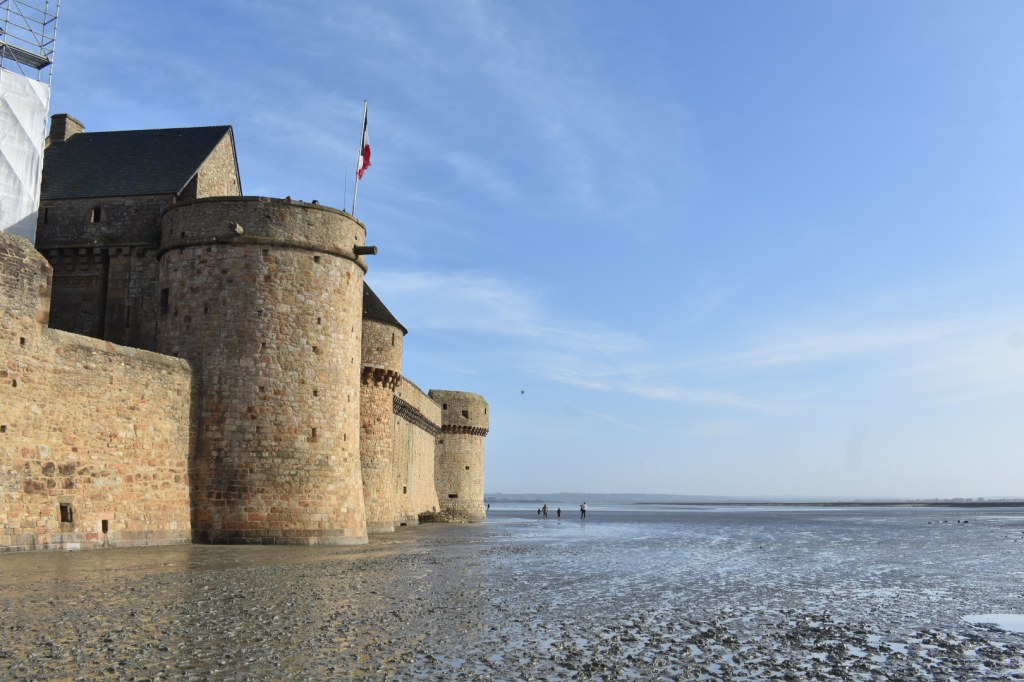
We had indeed picked a great day – weatherwise – for our visit. From the drop-off point, just before the island, we snapped photos of Mt Saint Michel under a pale blue sky at low tide.
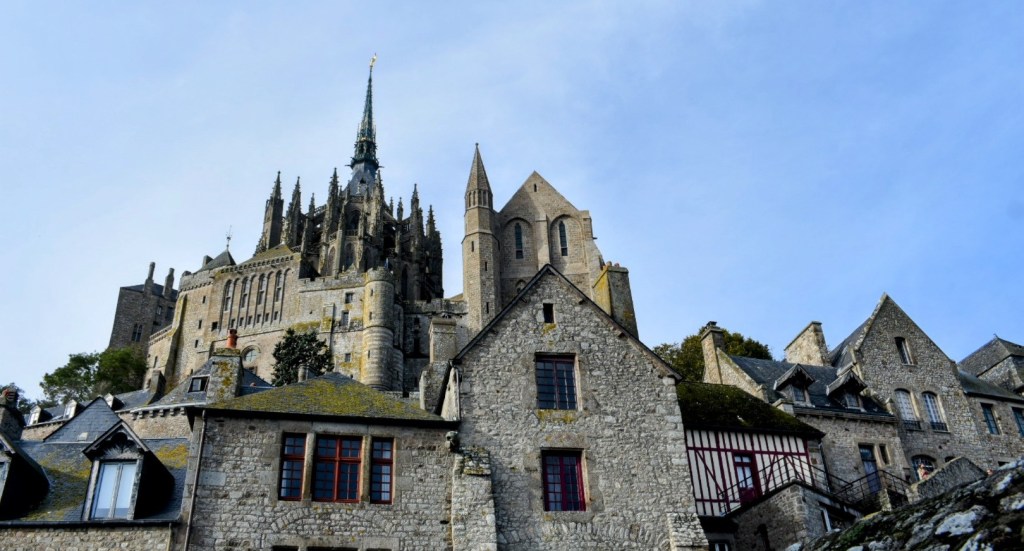
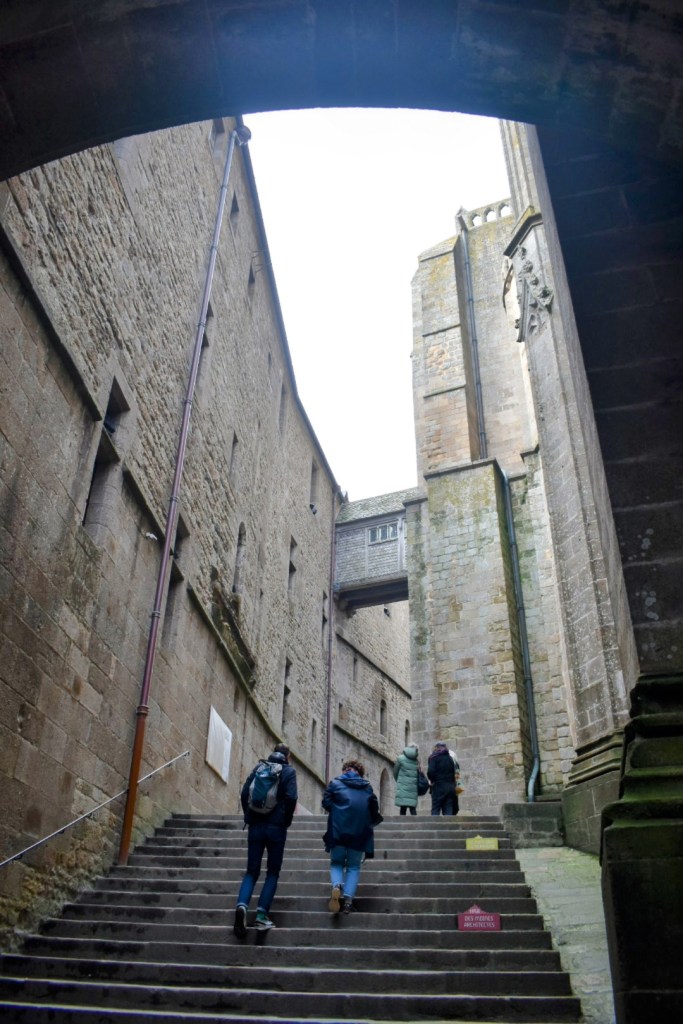
In keeping with medieval town planning, the island’s main thoroughfare is rather narrow and enclosed. It would have been easy to imagine life in Mt Saint Michel in the Middle Ages, though I doubt the smells would have been the same.
Arriving early gave us a head start on the tourist buses and the hordes of people who descended on the island around noon.
The large number of visitors only exacerbates the discomfort of this experience. Fortunately, an alternative route along the ramparts provides much-needed ventilation and offers stunning views across the bay and the mudflats below.
We saw trails of people snailing across the mudflats – it was risky given the swift tides and the possibility of quicksand.
Observing from the rampart, it becomes clear why the English forces were never able to capture this formidable stronghold. It is arguably the most impressive castle I have ever visited.
No visit to Mont-Saint-Michel would be complete without a visit to the hilltop abbey.
On this island, all roads lead to the abbey.
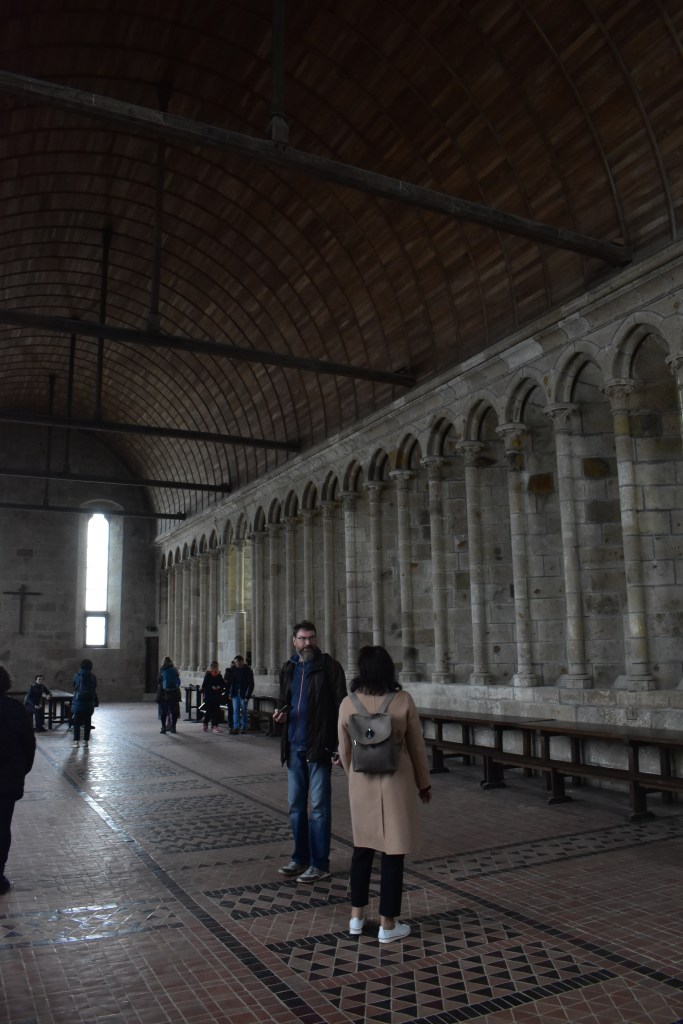
It was interesting – as an Irish person – that the Irish saint Saint Columbanus (543–615AD) is credited with founding a monastery in St Malo in 616 AD (as well as a number of monasteries after 590AD in the Frankish and Lombard kingdoms, most notably Luxeuil Abbey in present-day France and Bobbio Abbey in present-day Italy, according to Wikipedia).
Fran and I kept wandering up the stone footpaths the seemed to be designed to frustrate any invading soldiers, rather than aid penitent pilgrims.
It is interesting that during the French Revolution (5 May 1789 – 9 November 1799) the monks and nuns who lived on the island were expelled by the revolutionary government. (It is estimated that in France at the time around 100,000 monks and nuns were thrown onto the street from because the government regarded them as were “useless and selfish”.
Following the celebration of the Monastic Millennium in 1965-1966, a small community of Benedictine monks moved to the abbey in 1969. In 2001, it was replaced by the Monastic Brotherhoods of Jerusalem. Today, a dozen monks and nuns live in this national monument.
The high point – literally and figuratively – of the island is the Abbey. A veritable architectural feat, the abbey gives vertigo and disorientates. What is appealing is its verticality. Its location at the top and on the side of the rock requires a complex organization in superposition and winding.
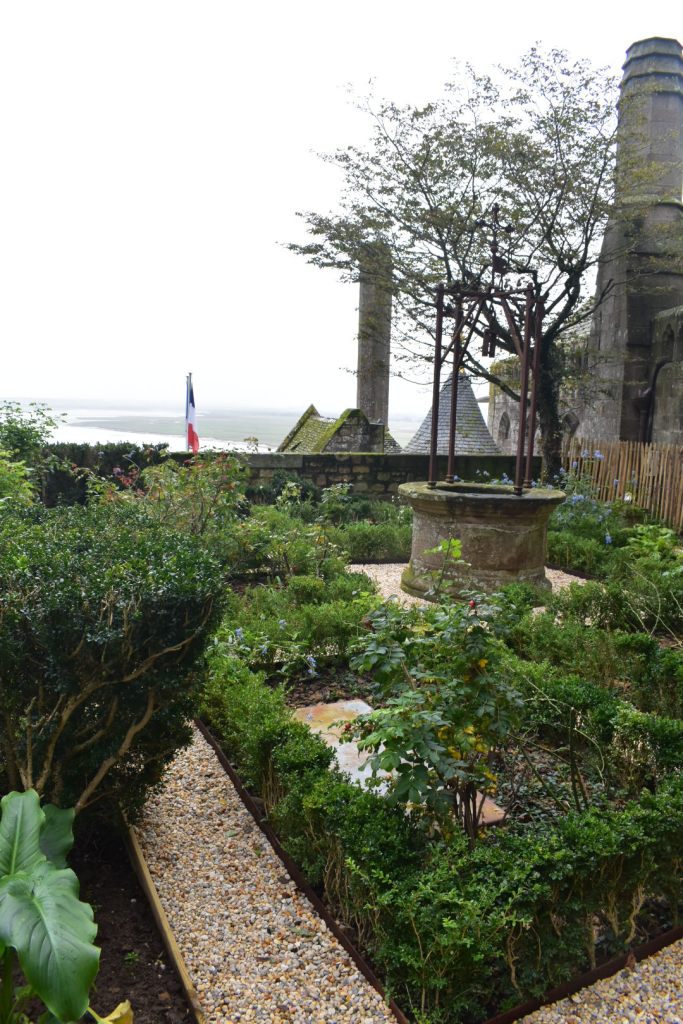
As you wander around you will encounter roped-off areas – the renovations that started in 1874 – continue to this day.
“The extraordinary restoration sites are multiplying at the abbey in order to preserve its exceptional character and to keep it in the best possible condition for future generations. The cloister, the statue of the archangel, and more recently the buildings of the wonder have been restored” according to www.abbaye-mont-saint-michel.fr.
The Abbey is a church, so visitors are expected to be respectful. (Oh and there is a 13 Euro entry fee).
While we were visiting the abbey a Mass was being said. About a quarter way through the service the priest paused to ask a tourist to stop videoing the proceedings.
Depending on the number of visitors, it takes about 45 minutes to 1 hour to walk from the parking lots to the entrance of the abbey.
Due to its location at the top of the rock and the important number of steps, access to the abbey requires a good physical and health condition. The monument is difficult to access for persons with reduced mobility, people with certain health issues and strollers.
Be aware: People with suitcases or large bags are not allowed. Smaller bags (smaller than the cabin size) are accepted. The monument does not accept any luggage for storage.

It was mid-afternoon when Fran and I left the island and made our way across the causeway. The weather had already changed, the wind now had an edge, there were occasional drops of rain and the grey clouds sat threatening overhead. There was rain on the way
We had missed seeing Mt St Michele at high tide, but we had climbed to the Abbey, wandered the battlements and enjoyed our “pique-nique” in a small alleyway and watched the throng of tourists march past.
As Fran and I boarded the shuttle bus back to the car park we realized we had dropped our carpark ticket … somewhere. It was too late to retrace our steps, so we went to the information office and had to buy a “get out of the car park” ticket.
It was then we discovered that neither of us could remember which car park we had left the Vitara in. With the rain slowly developing we searched the six car parks – scrambling through hedges in frustration until we found the hire car … and left Mt Saint Michel.
Fran and I enjoyed our day in Mt Saint Michel, not sure we would make a return visit.
As St Malo came into view Fran remarked: “Every morning I want to escape the Airbnb, and every evening I love coming back to it”.
Getting there
To get from Paris to Mont Saint-Michel, the most common and convenient way is by train combined with a shuttle bus:
From Paris Montparnasse station, take the direct NOMAD train to Pontorson, which typically takes about 3 hours 45 minutes. This train runs daily from around June to September and also on weekends outside these months. The ticket price is around €29 one way, including the shuttle bus transfer to Mont Saint-Michel.
From Pontorson train station, a shuttle bus runs to Mont Saint-Michel (about 10 km away). The shuttle ride is included in the train ticket. These shuttles coordinate with train schedules and take you close to the Mont’s entrance.
Alternative options:
Take a TGV (high-speed train) from Paris Montparnasse to Rennes (about 2 hours), then transfer to a Keolis bus from Rennes to Mont Saint-Michel (about 1 hour).
Direct long-distance buses operate from Paris to Mont Saint-Michel with companies like Flixbus, but these run mainly in the high tourist season (June to early September) and take about 4.5 to 5 hours.
Driving is also possible, around a 4.5-hour drive (~320 km) from Paris, with parking available outside Mont Saint-Michel and free shuttle buses to the site.
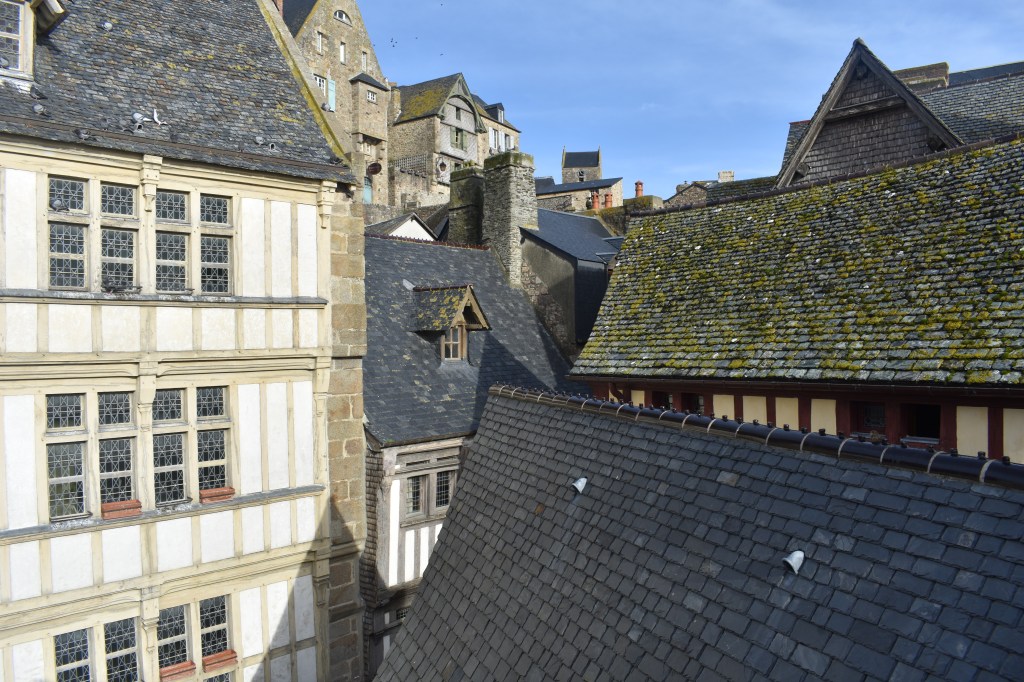
 on the road less travelled in Ireland and france