Fran and Conal escaped Paris, managed to have hire car “incident” at Rouen, the travellers arrive at their next destination, St Malo, Brittany.
By Conal Healy
October 26, 2023: Its our first morning in St Malo, Brittany, in north-west France. Fran and I were still recovering from the events of the previous day. The previous night we had arrived at St Malo, it was dark. We were exhausted and hungry (hangry even).
We had trouble finding the correct address in Avenue du 47E Regiment Infanterie, then Google Maps telling us our destination lay at the end of a narrow blind alleyway in St Malo which was lined with parked cars on both sides.
This was a nightmare to reverse up in the dark, especially after leaving Paris that morning and the adventure with the cars from Rouen.
Fran spotted a local boulangerie that was closing up, but managed to buy a few things. Fran spotted a local paper sitting on the table and enquired (in French) if was a free paper? The owner snapped a “Non” at Fran and almost flung the bag of baked goods at her.
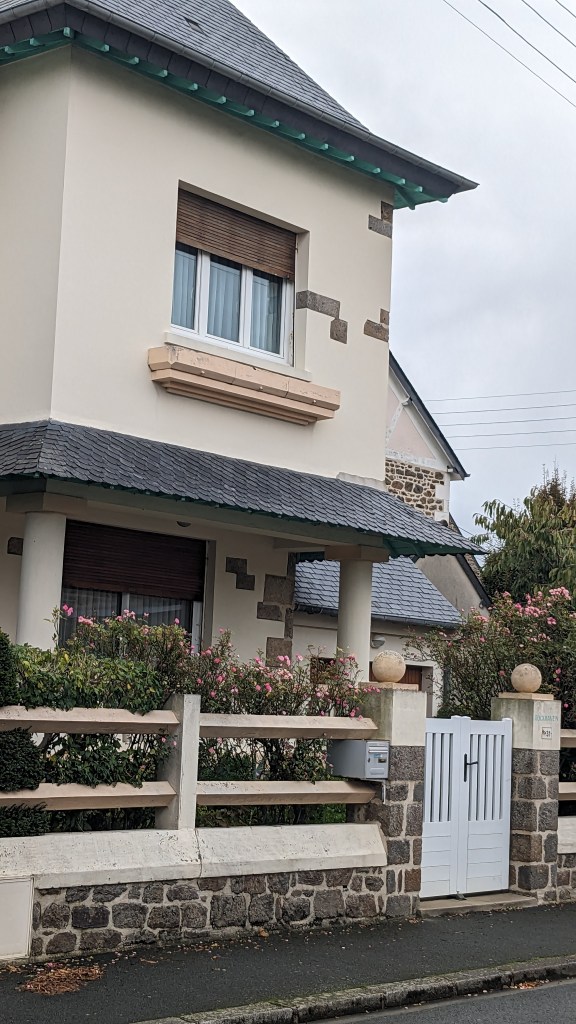
We eventually found the Airbnb. It looked great in the photos. It had a “Japanese garden”, at modern studio apartment that was attached to an old traditional two storey granite stone Britanny house. This was in the Courtoisville suburb – with beautiful villas all around. With an eight minute walk to the beach, which is on the English Channel, and is part of the Atlantic Ocean.
None of that mattered on the night we arrived in St Malo.
We knew the Airbnb host was German, what we didn’t expect that she would give us the full Germanic rundown of everything in the Airbnb. Literally everything – “The TV has both French and German stations”, “You are not allowed to bring any suitcase up the stair – you will mark the (freshly painted) walls”.
Fran bore most of the information assault, I sat slumped on the couch in need of food and alcohol (“Nouson suis morte de fatigue”, Fran explained, He is dead tired).
It is not everyday that I am involved in a road accident and still have to drive across Northern France. I just wanted to the Airbnb host to (and I quote from my travel journal) “Go the F*CK away”. Eventually she did.
Dinner that night was three tired pieces of pizza. No grog. It would have been a night when one drink would have been too many, and 50 drinks not enough.
Making a move
Our sleep that first night was “interesting”. The bedroom in the small studio apartment was on a mezzanine level, up a very steep stairway … really it was a ladder. “A law suit waiting to happen” was how Fran described it. (Fran was the first guest to ascend the stairs.)
The bed was tucked into the bottom slope of the ceiling, Fran and I tried to sleep – but the sloping ceiling was too close to our faces, a few times I sat up and almost grazed my forehead on the ceiling, a few times I stretch my legs out … and hit the ceiling. So Fran and I swapped and slept at the “bottom”. (Can’t have footprints on the ceiling!)
One of the first chores in the morning was to use the Airbnb’s washing machine. We had done a wash in Paris a few days earlier. Now it was time for another one. Soon every available space is draped with drying clothes – including the heated towel rack.
The studio apartment was so small that we declared a Zone Rule: In a designated area, ie kitchen, bedroom, or lounge, only one person could be standing, the other person had to sit down, or move elsewhere.
We could sit at the kitchen table and reaching into the fridge without leaving our seat.
After the Run From Rouen, Fran and I decide to stay clear of the car and to spend the day exploring Mt Malo on foot.
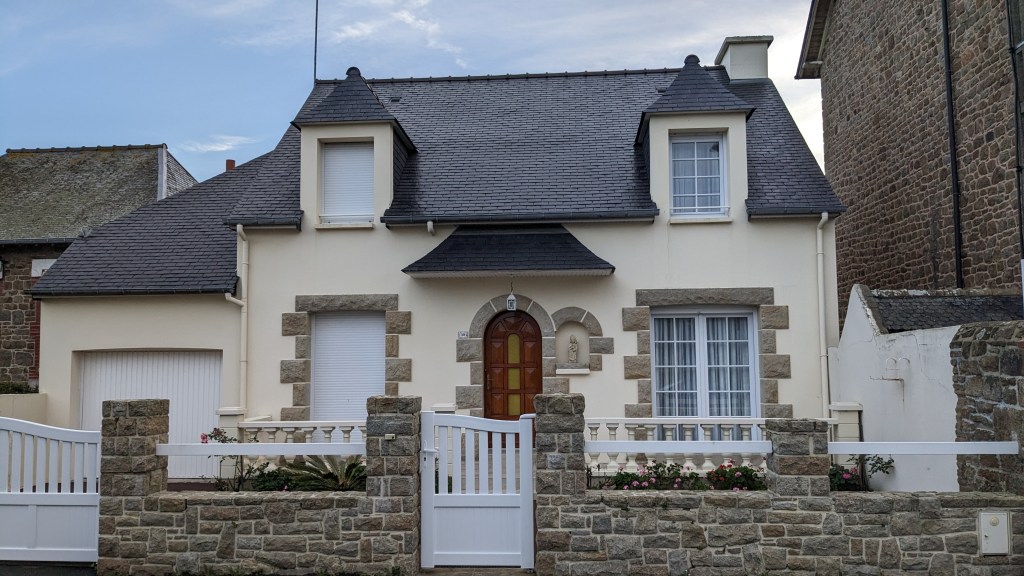
I set off from the studio, through the garden, being sure to lock the front gate and did a “blocky” camera in hand. I was getting orientated – looking at the sturdy, stone Breton houses. These were houses built for the Atlantic elements. St Malo is famous for its giant ocean swells.
Later that morning Fran and I set out to explore the town.

The history of St Malo
Saint-Malo has a rich history that includes a variety of notable events and people: The city was named after Maclou, a Welsh monk who settled on Alet Rock in the 6th century. The name evolved from Maclou to Malo, and eventually to Saint-Malo.
The area was originally inhabited by Gauls in the 1st century BC and was known as Reginca or Aletum. The first settlement was built by Celtic tribesmen to control the Rance River.
Saint-Malo became known as “The Corsair City” because of the many corsairs who lived there and fought for the king against enemy ships.
During World War II (in 1944), Saint-Malo was almost completely destroyed by American bombing and shelling. The city was rebuilt over 21 years, and the Saint-Vincent Cathedral was restored.
Other notable events: In 1144, the town was given the status of rights of asylum, which attracted thieves and rogues. In 1590, Saint-Malo declared itself an independent republic. In 1758, the British attempted to capture the town in the Raid on Saint-Malo.

A forest of logs
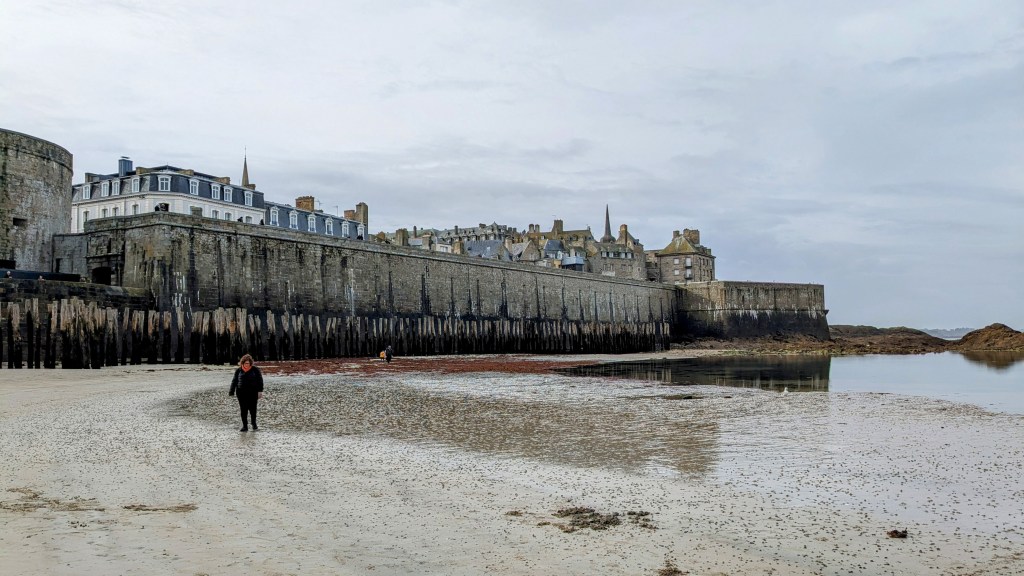
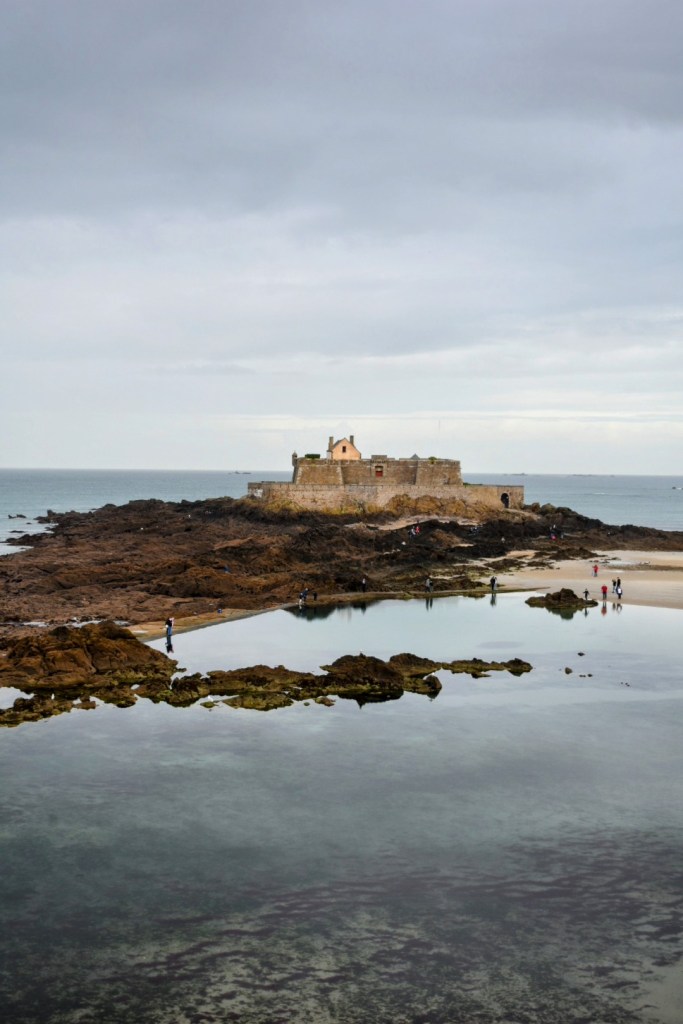
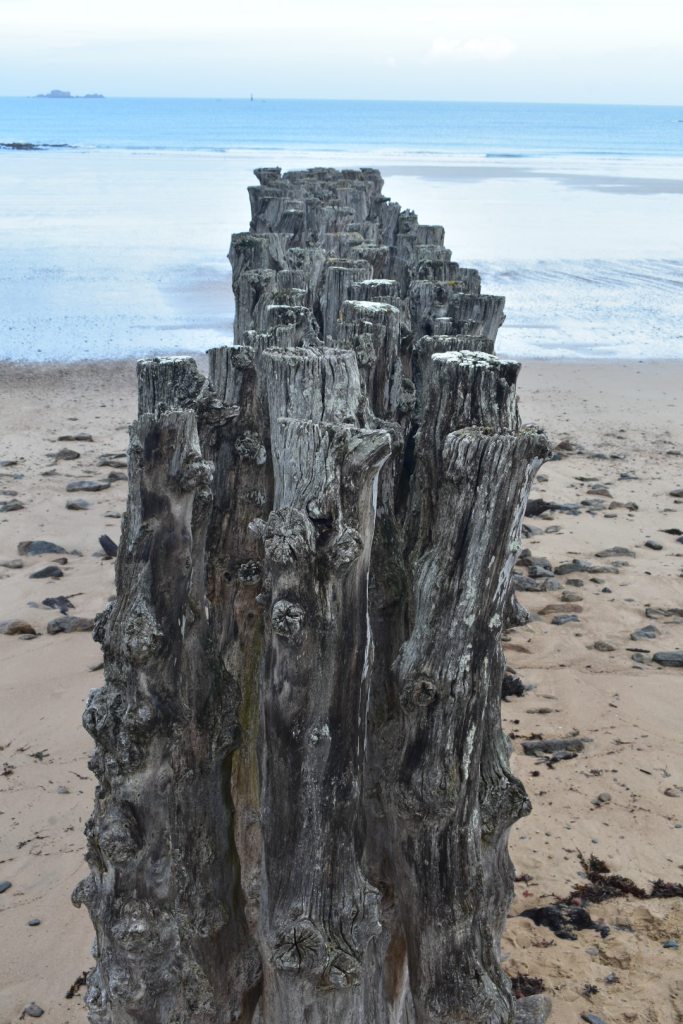
We walked to the long seaside esplanade (ducking down a side street, and onto the main drag to inspect a local boulangerie for sweet treats). The tidy was out so we got to see the forest of vertical tree logs used to break up incoming waves.
According to website odditycentral.com: “Seeing Saint Malo at low tide and then again at high tide is like looking at two completely different towns. The buildings and the way they are laid out are the same, but the existence of a beach as wide as the eye can see at one point, and the complete lack thereof just a few hours later is truly strange.
“And not only does the ocean come in hard at high tide, but it’s strong as well, with giant waves pounding against the waterfront and splashing up to the top of exposed buildings.
“At low tide, the ocean is barely visible from the promenade of Saint Malo, a medieval walled city with a long history of piracy. In fact, the distance from the edge of the waterfront to the ocean is about 2 kilometers. But the over 3,000 large wooden piles sticking out of the sand in straight lines lets you know that not everything is as it seems.
“As the sun descends towards the horizon, the water level starts to rise, and before you even realize what’s going on. It completely floods the beach and starts pounding away at the concrete waterfront. Over the course of six hours, the water level can rise by more than 13 meters, at a pace that some locals compare to a person walking really fast. To make sure no one gets caught by the high tide, lifeguards make sure that no stragglers remain on the soon-to-be-flooded beach every evening.
“Those wooden piles we mentioned before? They are the breakwater designed to absorb some of the massive power of the waves and protect the town. But even so, the water splashes impressively against the waterfront almost every evening, drawing large crowds curious to witness nature’s power. And while the spectacle is definitely something worth experiencing, there is a reason why the promenade is lined with signs that read “DANGER!”.
“The ocean puts on a show in Saint Malo all year round, but the tides are particularly high around the equinoxes, in March and September, and when there is a full moon. If these conditions happen to coincide with a storm, things can get pretty dicey for anyone caught in the open. Waves dozens of feet high sweep over the wooden breakwater, smashing into the waterfront, with huge splashes washing the most exposed buildings”.
We walked, at low tide, along the promenade to the Intra-Muros, the old part of the city.
A striking granite city, looking proudly out to sea. A wave of emotion washes over anyone who beholds Saint-Malo… Intra Muros, its old town, which has sheltered behind the stone walls since the 12th century, beckons you in to discover the spellbinding charm of its narrow streets.
Walking the ramparts
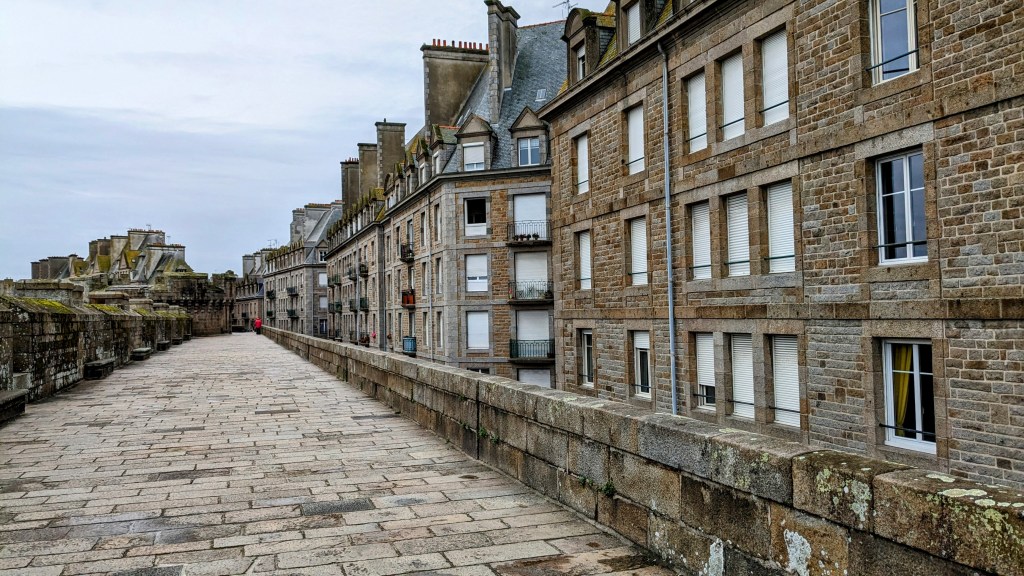
We entered through Porte Saint-Vincent, walked round the ramparts to stretch our legs – the reward was breathtaking panoramas from every corner. Architectural gems and delightful shops abound. Not for the first time did we mutter: “It would look amazing in the sun shine”.
On our To-List were:
- The ramparts: city enclosure consisting of towers (14th – 15th centuries), castle walls and bastions from the 17th and 18th centuries
- The castle: large keep (1424), general tower (1475), Quic-en-Groigne tower (1498 – 1501), Dames and Moulins towers (16th century)
- Saint-Vincent cathedral (12th c.) with its dazzling stained-glass windows
- Solidor tower with three keeps from the 16th century
The 18th-century Fort de la Cité d’Alet Sainte-Croix church and Saint-Ideuc church.
Fran and I walked the battlement under grey skies. We stopped to watch a small trawler unload its bags of just-caught seafood, knowing they were destined for dinner plates that day. Fran would inspect the architecture and eventually announce: “That is my gargoyle du jour”.
(The difference between a gargoyle and a grotesque is easy to remember. A gargoyle is a decorated waterspout that projects from a roof and carries rainwater away from the walls of a building, protecting it from damage, whilst a grotesque is a decorative carving that has no functional architectural purpose.)
We spotted to inspect a shop which seemed to specialise in wall tiles that were actual pieces of art.
There was also a shop that sold everything for a family day at the beach – buckets, spades, beach balls ..and plastic play swords and shields. How French!
Scene from a city
We are wandering around the narrow streets of the Intra-Muros and this low slung black sports cars speeds by. The “Karen” driving the car tried to get into an enclosed courtyard/car park that was protected by pop-up traffic bollards. She must have hit the remote control as she approached, expecting the bollards to retreat into the road. They didn’t and she smashed into the bollard. Undeterred, she reversed back, hit the remote and drove forward. Again she was expecting the bollard to retreat … they didn’t, and the car smashed into the erect bollard again. Fran and I walked away as the now-angry “Karen” got out of her car to abuse the bollards, inspect the damage to the front of her car and shout at an innocent passerby.
Sweet treat
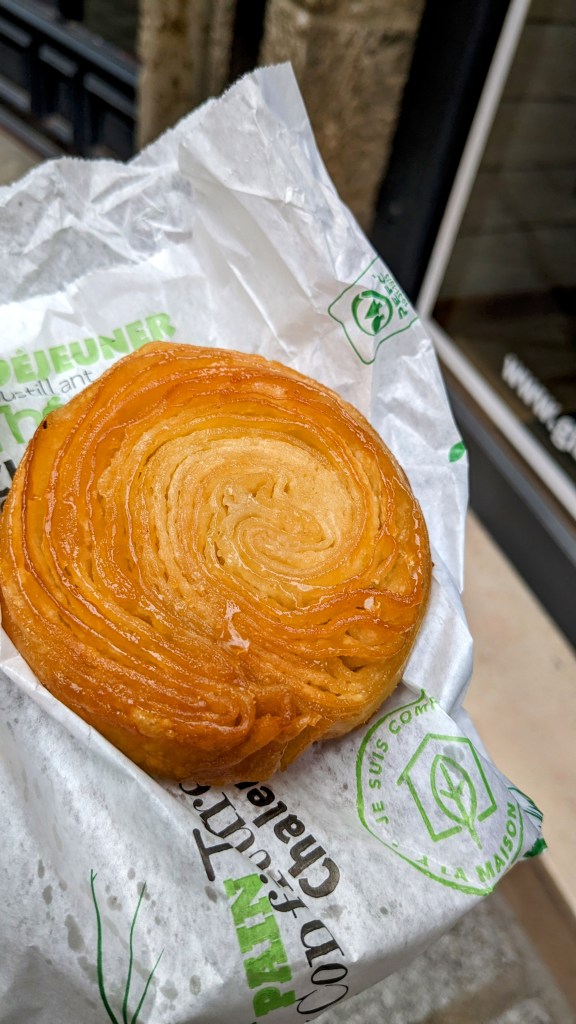
For a morning treat we tried the local sweet treat bun specialty – Kouign-amann. This is a cake that originated in the 1800s in the French region of Bretagne (Brittany). Its name is derived from the Breton words for cake (kouign) and butter (amann). The cake consists of layers of butter and sugar that are folded into a dough.
After a long morning of strolling around the Intra-Muros for lunch we treated ourselves to Crêpe bretonne (krampouezenn in the Breton language). It can be served plain, or with sweet or savoury fillings. The Crêpe bretonne can be made of wheat (sweet crêpe) or buckwheat (savoury crêpe). It came with a cup of local cider to washed the crepe down. (We opted for the cheese, ham and fried egg meal.)
It has to be said that a cup of cider and a plate of crepes … well, the world seemed a better place.
There is always and option to get a no-alcohol cider with lunch. Later we bought a bottle of local cider and discovered that particular cider was a 3% proof variety.
Rebuilding a city
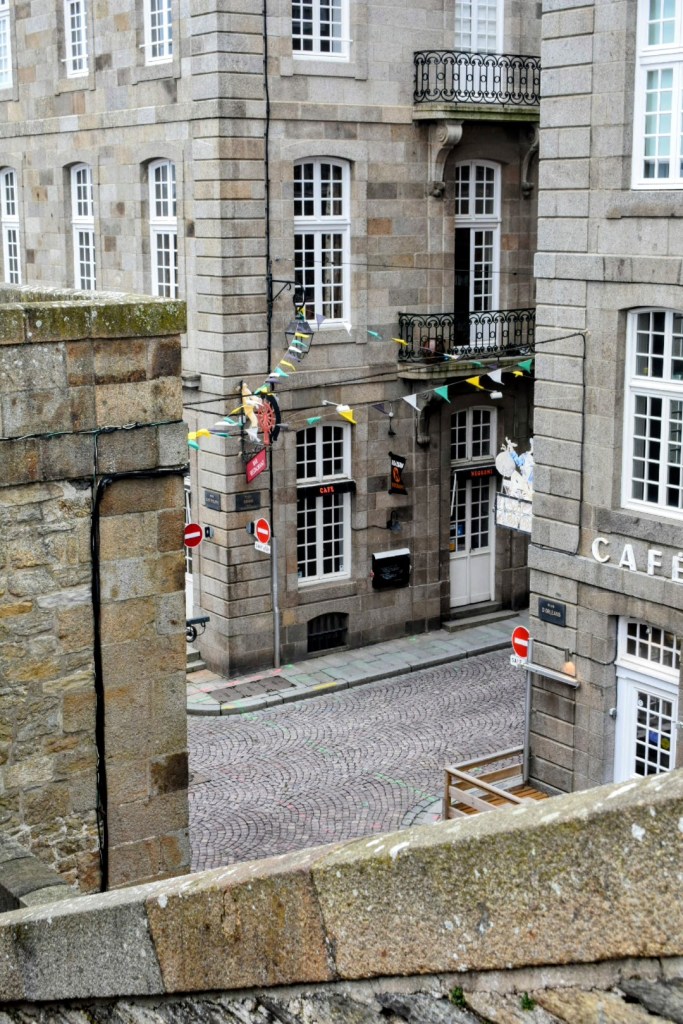
As you wander around the Intra-Muros there are plenty of historical signs. Some emphasise St Malo’s long history. There are signs that mention how the city was on the front line defences of Nazi Germany in the Second World War.
The Battle of Saint-Malo was fought between Allied and German forces for control of the French coastal.
The battle was part of the Allied breakout across France and took place between 4 August and 2 September 1944. The bombing and shelling of Saint-Malo almost completely destroyed the city, leveling nearly 80% of it.
United States Army units, with the support of Free French and British forces, successfully assaulted the town and defeated its German defenders. The German garrison on a nearby island continued to resist until 2 September.
While it was no longer considered feasible to use Saint-Malo’s port, it was believed to be necessary to capture the fortifications in the area to prevent German artillery from attacking Allied shipping using nearby ports.
After World War II, Saint-Malo was rebuilt over a 12-year period from 1948 to 1960. The city was mostly rebuilt in its original 18th century style, using original construction materials and following original city plans.
The result is that today, it’s hard to tell that most of the medieval city was rebuilt in the mid-20th century.
The first idea was to demolish the town and start over, but city authorities decided to rebuild instead. Stones from partially standing buildings were numbered and stored before being used in the rebuild. The castle was rebuilt and turned into the city hall, and the hospital and prison were moved outside the city walls. A few half-timbered homes from the 1600s were kept.
Reading the historical signs – in the 2023 – there is a definite “Don’t Mention the War” vibe with the inscriptions. On one sign the bombing of St Malo was described as (and I quote) “… an event that happened in the area”.
Fran and I had a pleasant time wandering around the Intra-Muros, ducking into churches, wandering alleyways, stopping to explore bookshops (marveling at the number of books published in French, including translations of popular non-French works).
As we left the Intra-Muroswe spotted seagulls squabbling over leftovers, we wondered – for a moment – if the seagulls in Australia squawked “Mine” when seeing food (as in Finding Nemo) would French seagulls say “Mon”?
As we were walking back to the Airbnb on the first day, I was stopped by a French mother with a young child. She was speaking French to me. The only word I understood was “Mer”. I figured the mother was asking for directions to the seafront, and directed her to keep walking straight … just keep going. She walked away happy.
Not for the first time, I was able to give directions to a local … despite only being in town for only a few hours.
 on the road less travelled in Ireland and france
Leave a comment