Fran and Conal visit Montmartre in Paris, navigating the area via metro and walking. They explore the artistic neighborhood, renowned for the Basilica of Sacré-Cœur and the vibrant Place du Tertre.

By Conal Healy
Saturday, October 21, 2023: With the market out of the way, Fran and I decided to head for Montmartre.
Google Maps is leading the way – we walk, ride the metro and walk again. We had missed Montmartre on our last visit.
We had opted for a prayer service at Sacre Coure, followed by a dash across Paris for a night walking tour.
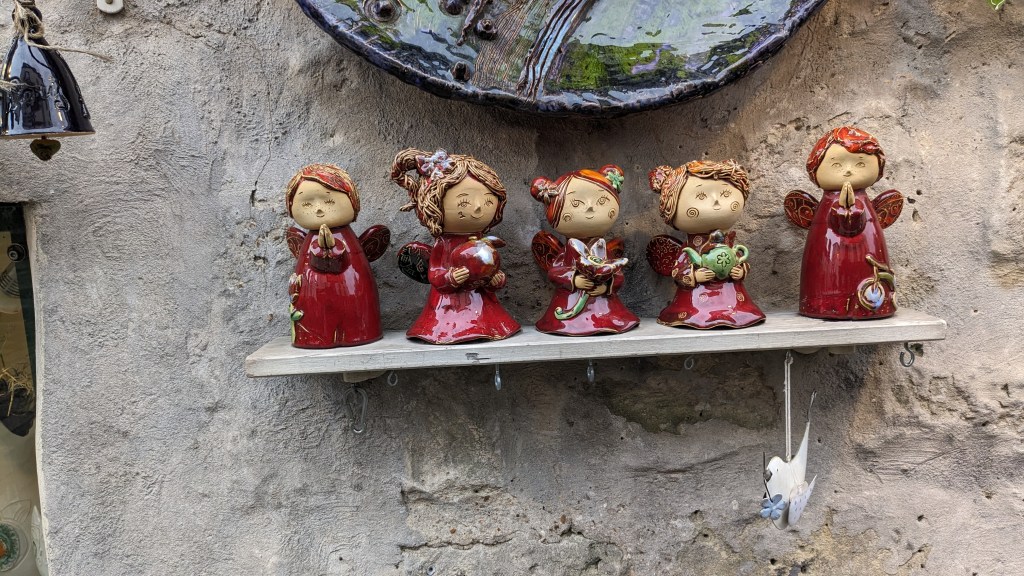
Montmartre is a large hill in Paris’s northern 18th arrondissement. It is 130 m high and gives its name to the surrounding district, part of the Right Bank. Montmartre is primarily known for its artistic history, for the white-domed Basilica of the Sacré-Cœur on its summit, and as a nightclub district.
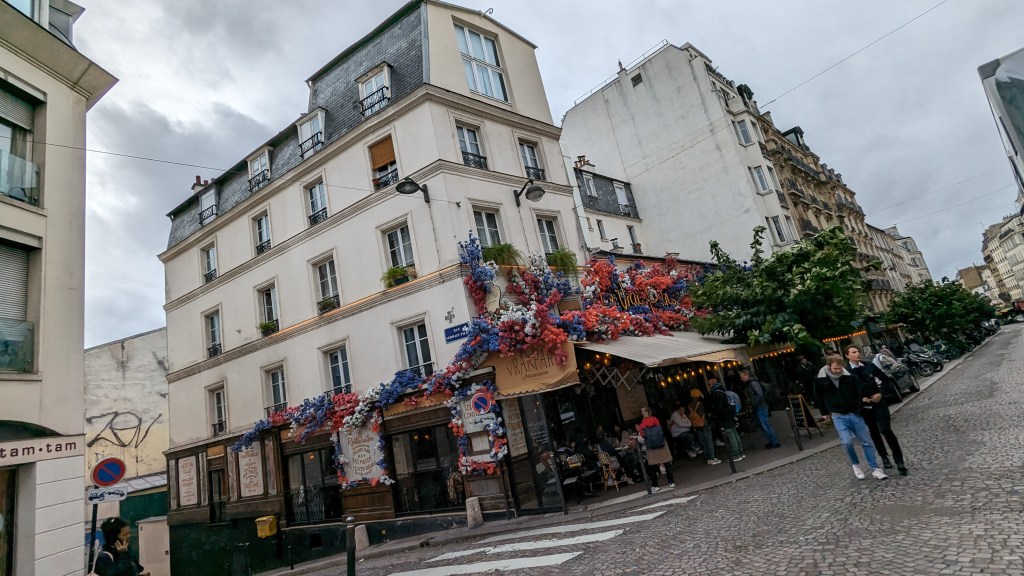
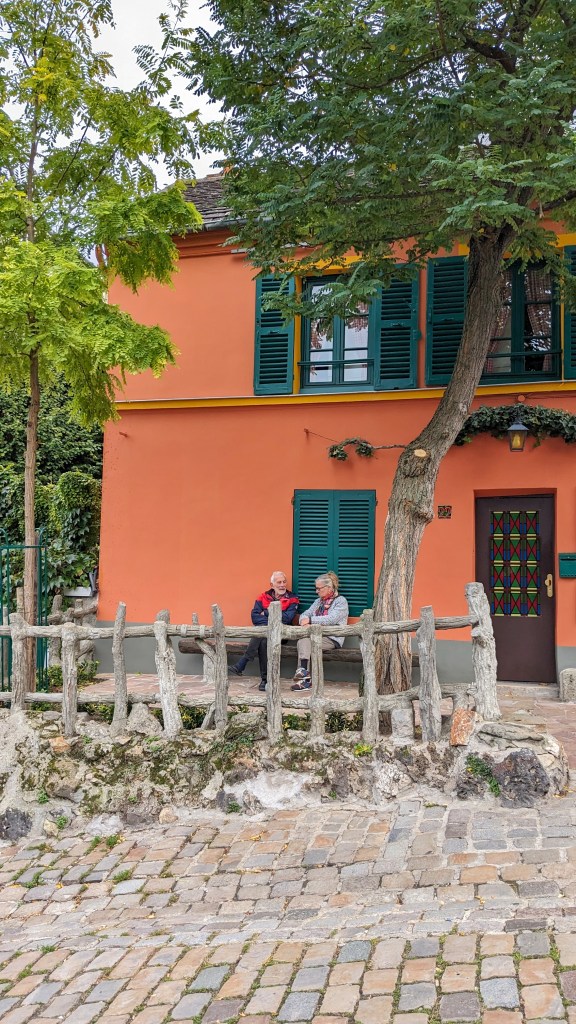
Montmartre is famous for its artistic heritage. It has a distinctive village atmosphere characterised by steep, winding, cobbled streets which makes it feel different from the rest of Paris. The white Sacré Coeur church crowns its highest point. The area in front of the church offers extensive views of the city.
Visiting Montmartre is now often seen as one of the top ten things to do on the Paris tourist trail. The best way to see it is on foot.
Napoleon III — the more famous Napoleon’s nephew — seized power in France in 1851. He maintained the family tradition by proclaiming himself Emperor.
Being Emperor gave him the freedom to put his ideas into action without having to worry about the inconveniences of political opposition or social impact.
His Imperial Majesty wished to modernise France. He turned his attention to Paris first. Napoleon III’s vision, shared by his highest administrative official Baron Haussmann who was his right-hand-man in the project, was to destroy the medieval heart of old Paris and to rebuild a modern capital worthy of the new Napoleonic-era.
Instead of the piecemeal, chaotic, medieval squalor of the old city, modern Paris should be clean, airy and full of light.
There was to be modern regular classically-inspired architecture and a series of prestigious railway stations. These used the latest building techniques of wrought iron and glass. They would bring France to Paris.
Wide, straight, tree-lined highways would open up vistas to Paris’s monuments, there would be squares and parks where people could stroll, watch and be seen.
It was to be the most awe-inspiring, modern, model city on earth, a planned scaled-up masterpiece, a fitting imperial capital worthy of the prestige of the Emperor’s famous family name.
The property speculators who helped Baron Haussmann and Napoleon III to systematically reduce swathes of old Paris to piles of rubble saw, for the moment, little opportunity in rural Montmartre.
Montmartre lay outside the scope of the Emperor’s masterplan; it sat aloof on the top of its hill, semi-rural, outside the city walls, on the edge of things.
That remoteness and geographically hilly awkwardness helped protect it from the wholescale demolition going on in the city at its feet. It meant that it remained radically removed in time and space from the modern geometrical city taking shape at its feet.
A donkey would take you up to Montmartre but the steep streets still defied most horse-drawn transport.
In Paris tumultuous change was afoot as great processional avenues and prestigious boulevards relentlessly and ruthlessly pierced the old city.
In Montmartre hens scratched in kitchen gardens, goats wandered between the shacks, mules brayed, painters perched by easels, the sails of the windmills stiffened in the breeze, the sun set, the moon rose, the cafés filled, absinthe encountered stomach and brain and the wisteria silently spread over house and through garden.

The idea of Fran and myself strolling to Mortmarte was not a good idea.
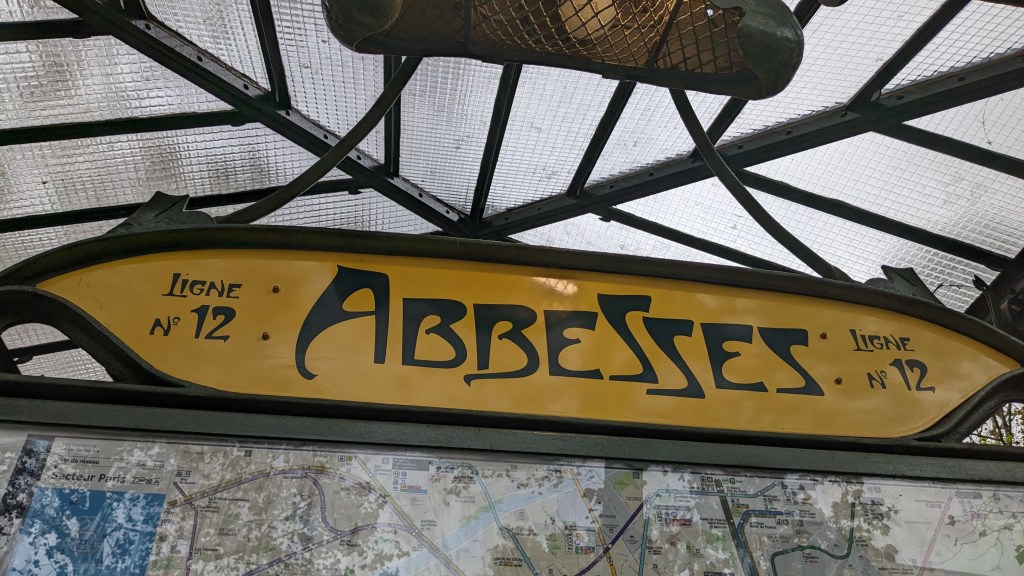
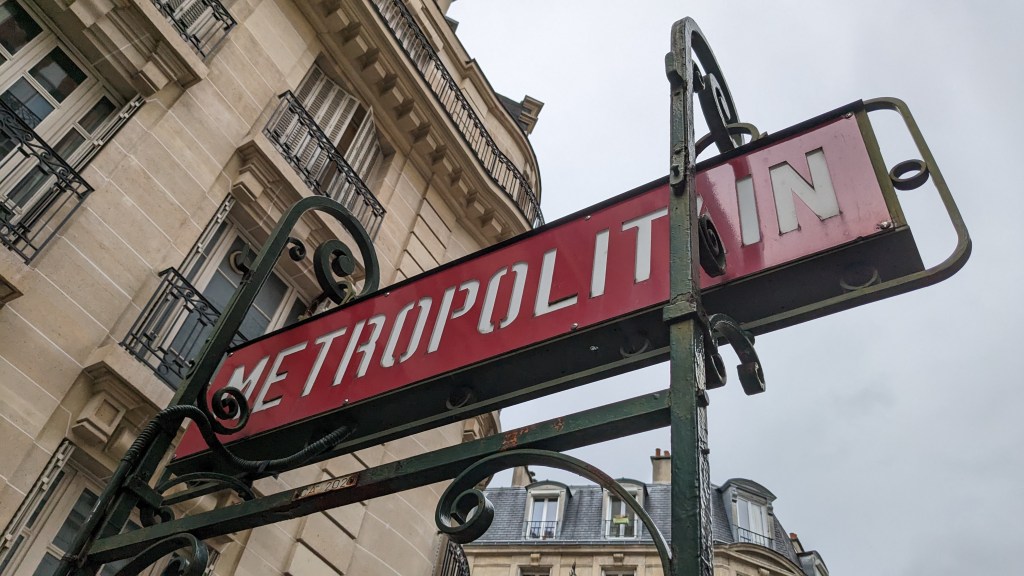
It would become a Day of Steps. We rode the metro to a nearby station. A sign at the station warned it was 144-step ascent to the exit. On we went, getting footsore with every step we took.
At the bottom of Rue de Calvary, Fran and I stopped and grabbed a few fromage and gambon baguquettes and sat back to watch the crowds (some sporting rugby team shirts) go by. More than one tourist muttered “Oh shit” when confronted by the steep series of steps leading up to Montmartre.
Situated in the very heart of Montmartre, one of the most famous squares of all of Paris is that of Place du Tertre, which is world-famous for its painters, cafés, and ambiance.
In spite of what you might think (because of the sheer number of artists working on the square), it’s actually pretty hard to become a painter on Place du Tertre. There are a limited number of places, which are set by the local town hall, according to one guide website solosophie.com.
Each year, only five or six new spots to paint become available, which is when the artists’ in residence on the square move away or pass away. As you can imagine, getting a spot is quite coveted and hard to get.
In order to gain a permit to paint on the square, artists must submit a portfolio of their work and, if accepted and a place becomes available, they’ll be issued a card which proves they’re allowed to work on the square.
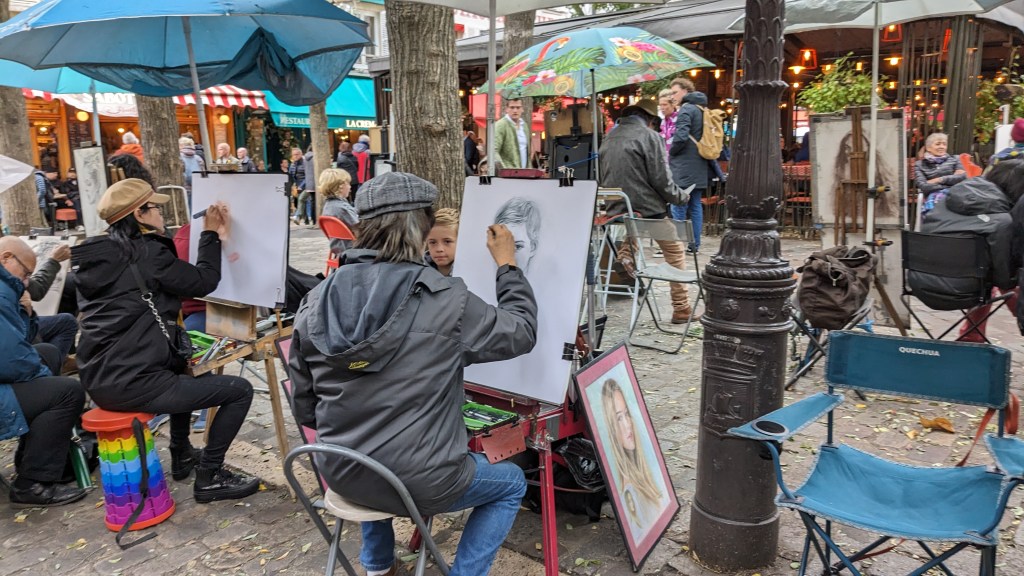
On Place du Tertre itself, there are small markings on the ground, around the central café terraces which dictate the 1 metre squared section that the artist is allowed to work from. It’s technically illegal for artists to work outside of this space in Montmartre, and artists caught doing so can face a fine.
“Please note that you should never take photos of the artists’ work close up. Many of the artists working here produce unique and original pieces and so will not appreciate having photos taken of their work. You are, of course, allowed to ask them questions about their pieces and buy a piece to take home as a souvenir!” suggests solosophie.com.
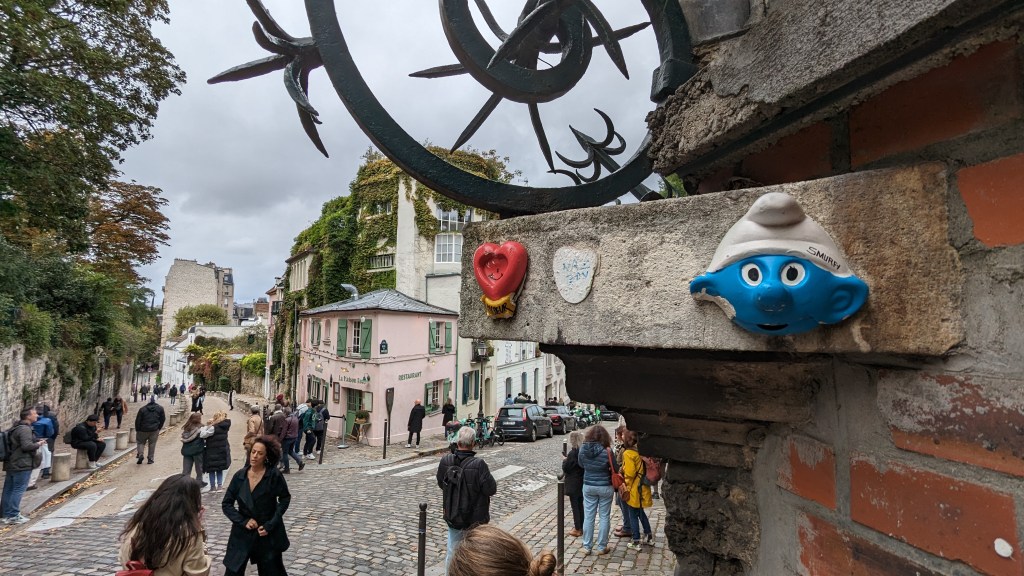
On the afternoon Fran and I visited we found it overcrowded, more like a scrum than a stroll. It was like being herded. There was plenty to things to photograph – including street art.
High points? Hearing a tourist guide sing her information to her clients.
The guide and singer Anne-Sophie Guerrier will bring you on a musical journey through Montmartre. This visit will retrace the life of famous singers who lived in the neightborhood : Édith Piaf, Charles Aznavour, Jacques Brel … to name but a few. Cost: 20 Euros.
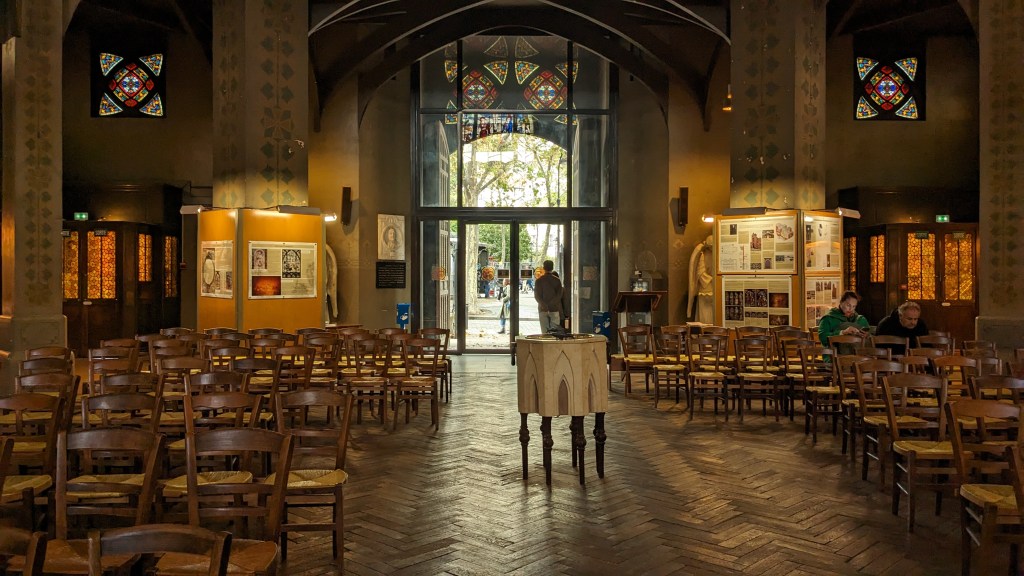
We found our way to Saint-Jean de Montmartre is a Roman Catholic parish church located at 19 Rue des Abbesses in the 18th arrondissement of Paris. It was built from 1894 to 1904 and is a good place to rest our feet.

We grabbed a metro back to the Rue Faubourg Airbnb in the late afternoon (to re-charge our phones, have a nap and get ready for a night out in Paris).
Eagle-eyed Fran had noticed that a nearby café/bar had a happy hour deal – five euro cocktails/beers. Who could go past that?
(Footnote: After a few Happy Hour drinks, we decided to stay for dinner. I had the cheeseburger, chips and salad. Fran had the pizza, couldn’t finish it and somehow managed to get the café to give her a doggy bag to go. We stopped for more beer and wine at the local Franprix and retreated to the Airbnb to watch Netflix until late in the night. Steps: 21,700.)

 on the road less travelled in Ireland and france
Leave a comment