It’s a Saturday morning in Paris, time for Fran and Conal to visit a flea market and look for a bargain.

By Conal Healy
Saturday, October 21, 2023 (11am): One of my favorite memories from my first visit to Paris (in 1977) was visiting Les Puces, the Saint-Ouen Flea Market near the Porte De Clingencourt.
For an Irish teenager the market was cosmopolitan, exciting and a place to get bargain clothes. Over the decades I have tried to get me in Paris at the weekend, so I could visit the market.
There are lots of other open air flea markets in Paris, you just have to know where and when they are. What may look like a large car park during the week can be transformed into a bazaar on a Saturday or Sunday morning.
Often described as the largest antique market in the world — and definitely the biggest and oldest in town — Paris’ sprawling Saint-Ouen Flea Market is a treasure hunter’s dream destination.
Technically encompassing 15 individual markets, each with its own specialties, this 150-year-old collection of stalls and warehouses lies just north of Paris proper.
It’s almost too easy to lose track of time browsing the thousands (yes, thousands) of vendors’ wares (and practicing haggling in French).

With a destination in mind, Fran and I wander down the Canal St Martin and relive our 2019 stay in the area.
Then up to Rue Magenta, stop for a coffee and hot chocolate at a cafe near Gare de L’Est. Again, Fran uses her language skills and also orders (a croissant and a escargot with raisins) and pays – in French.
Along the way we drop into a local church to take photos. Stopping at churches became a regular daily visitation for Fran and I. No day was complete with a visit to church, or a cathedral, or a basilica.
Our first encounter with Paris Metro system did not go well. We had planned to use our bank cards to buy a five-day Metro card … the machine didn’t like our card and we had to feed the machine 80 Euros in cash for our passes.
This is Fran’s second time in Paris so we ride the Metro like locals – look bored, stay silent, check our phones and avoid making eye contact with anybody else.
Les Puces (it is signposted that way) is best visited in the morning, it can get busy in the afternoon.
Be warned – it can be intimidating. You will be approached by hawkers trying to sell you the latest mobile phone at a knock-down price … but I had always resisted.

I have always felt comfortable visiting Les Puces, but there are suggestions (see below) for tourists visiting the area.
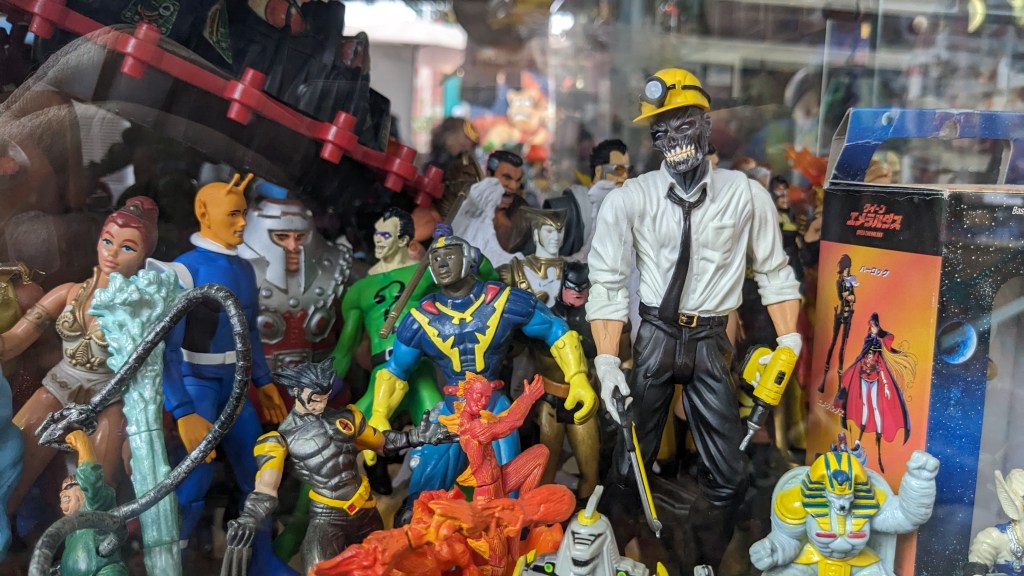
Fran and I spent a pleasant few hours wandering the stalls, the book shops, and stopping for a coffee and a sweet treat … and resisting the temptation to buy vintage cinema posters, French postcards or rare sci-fi collectibles.
It was interesting to see Parisians tending their stalls, eating their lunches at small picnic tables with a glass of wine to aid digestion.
Footnote: There are lot of local flea market across France, search for Brocabrac.
How to get to Les Puces
Go get there by metro, head to Porte de Clignancourt on Line 4 and follow the crowds towards the large concrete overpass.
If you are looking for antiques, don’t waste too much time looking through the clothing, African objects and household goods on streets along the way.
The market and neighborhood is very colorful and you will love the diversity of personalities, stall keepers and products for sale!
The 18th arrondissement, where the Puces are located, is in a less affluent part of Paris and the market gets very crowded. You can safely stroll around here during the day.
Tips for Les Puces
Hide your wallets under your shirt or sweaters around your neck. You don’t need a lot of cash anyway, as most dealers accept credit cards.
Don’t bring your passports to the Flea Market or miscellaneous credit cards that you won’t use: you do not need your passports to buy there, because antiques do not have VAT for the tax refund.

History of the Flea Market
The history of the flea market dates back over two centuries, when rag and bone men scoured through the garbage of Paris at night to find valuable junk to sell on.
They were called ‘crocheteurs’ or pickers. The romantic term was ‘pêcheurs de lune’ or ‘fishermen for the moon’.
Many set up their temporary stalls within the Paris walls in sleazy neighborhoods, but because these districts were full of pickpockets and thieves, they were chased out of the city walls to Clignancourt, Montreuil, Vanves, etc.
The largest of these flea markets is the one at Clignancourt, but the other two continue to this day.
The rag and bone men gathered outside the walls of Paris at the Porte de Clignancourt and set up temporary stalls where they hawked their wares. Eventually, they formed groups of stalls to attract more customers. The more enterprising traders began to ‘trade up’ in terms of goods and eventually it became popular for Parisian collectors and antique dealers to shop there for bargains.
By the way
You can find pretty much anything at the Montreuil flea market – even laundry detergent and toilet cleaner (at a discount, no less). To discover hidden gems, you’ll need to dig through the heaps, quite literally.
Everywhere, among the colourful tented stalls, piles of clothes, shoes, and boxes overflowing with tableware and handbags create a charmingly chaotic scene.
Those who enjoy rummaging will love it here: it’s a real treasure hunt for budget-conscious adults. If you do it right, you can fill your boots with homeware and clothes for less than €10.
The atmosphere is great, and there are even a few street food stands to keep you fuelled. For those seeking designer pieces, you’ll have to get up early: in Montreuil, some connoisseur stalls are picked clean before the market even opens…
 on the road less travelled in Ireland and france
Leave a comment