What do you do on a rainy day in Cork? It was a question Conal and Fran asked The Google Machine. And were not happy with the suggestions. To their surprise, a passing senior citizen provided them with a list of options which were better than Google.

By Conal Healy
Cork is the second largest in Ireland, after Dublin. The city is built on the River Lee and is said to have been founded by St Finbarr who build a monastery in the seventh century.
The city was raided (and burned) by Viking sea-pirates. The Anglo-Norman invasion in 1172 resulted in both the Danish lords and local McCarthy chiefs having to submit to Henry II, but Cork has always had a reputation for independence and stubborn resistance: it came to be known as “Rebel Cork”
The CBD of Cork was also burned by British forces on the night of December 11–12, 1920, during the Irish War of Independence.
Cork has been described as “a modern, vibrant and progressive urban centre, a status underlined by the designation of Cork as European Capital of Culture in 2005”.
Lonely Planet listed Cork as one of the Top Ten cities in the world to visit in 2010. And gushed: “Cork also has some of the best restaurants in Ireland or England …Sophisticated, vibrant and diverse while still retaining its friendliness, relaxed charm and quickfire wit, Cork buzzes with the energy of a city that’s certain of its place in Ireland.”
On a cold, stormy day in mid-October, Cork city was not exactly shining when Fran and I hit town.
The previous day, Fran’s only pair of shoes had been soaked by rain, so a trip to buy new shoes was called for. While Cobh had many attractions, it is lacking in department stores and shoe shops.
We braved the floodwater and Storm Babette and headed for Cork city. Rather than brave inner-city traffic (and already-flooded streets) with drove to a Park and Ride station and caught a bus into the CBD.
In the pouring rain we tried to get our bearings. We were looking for our favourite Irish store, Pennys.
Luckily a local saw us staring at Google Map and came to our rescue. “Are you lost?” asked the young man politely, and directed us to the shop … before walking away in the rain.
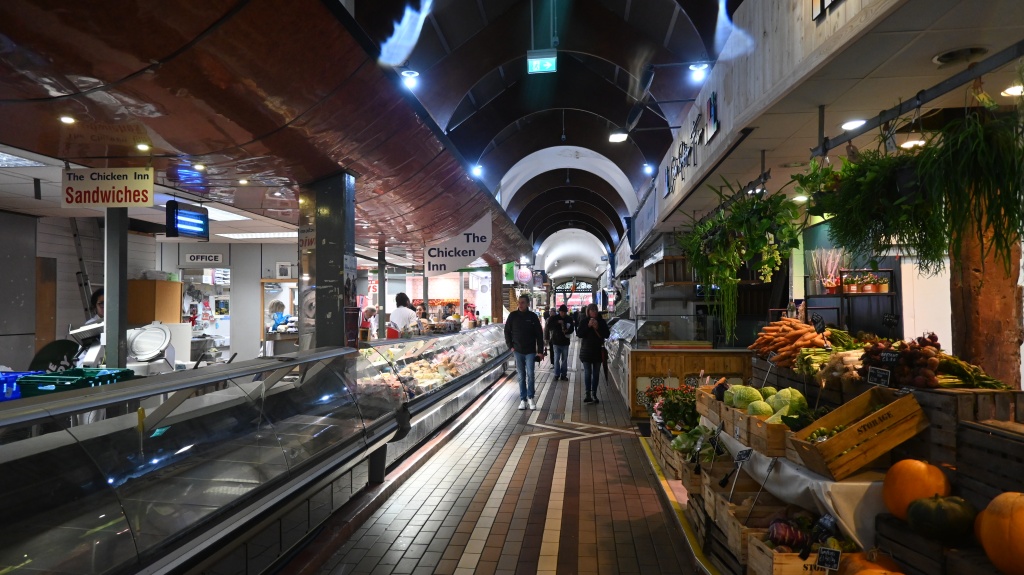
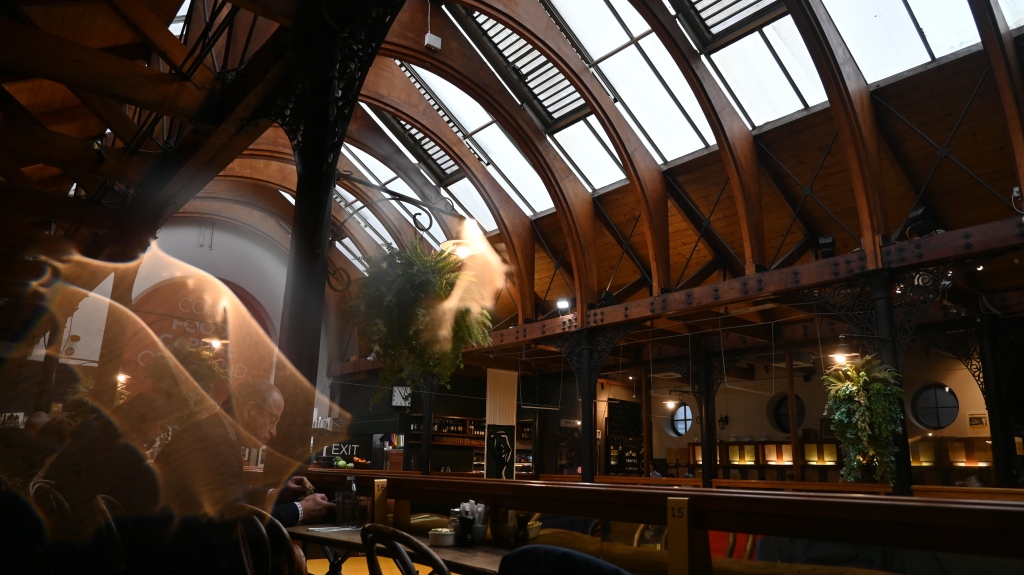
Inside the English Markets in Cork

We found the store (and got the sensible walking shoes), but nearby was a Butler’s Chocolate Cafe which promised hot chocolate and cakes.
Who were we to refuse such needed treats on a rainy day? So we stepped inside and decided what we did next.
We tried searching the Google Machine: “Things to do on a rainy day in Cork” … but nothing appealed.
Fran and I were still pondering our telephone screens when we stepped out of the café. What do we do? Where do we go?
Decisions … decisions … decisions …
Then a kindly senior member of the Cork community stopped and asked if we were lost.
Rejecting everything that Google had shown us, I asked the woman: “What would you do on a rainy day in Cork?”
I think she was expecting me to ask for a particular street, or attraction … instead I was entrusting her with a Google question. How strange, she might have thought.
The sprightly pensioner thought for a moment and gave us her Rainy Day Recommendations, and included directions to them too. Fran and I were amazed by her friendliness, insight and understanding – “It is a shocking day… all this rain” she added and bustled away in the downpour.
Five minutes later we had escaped the heavy rain and were wandering The English Market.
The English Market is a food market in the center of Cork. The market is regarded for both its mid-19th century architecture and locally produced artisan food. The market has become a tourist attraction, has developed an international reputation, and has been described by chef Rick Stein as the “best covered market in the UK and Ireland”.
The term English Market was coined in the 19th century to distinguish the market from the nearby St. Peter’s Market (now the site of the Bodega on Cornmarket Street), which was known as the Irish Market.
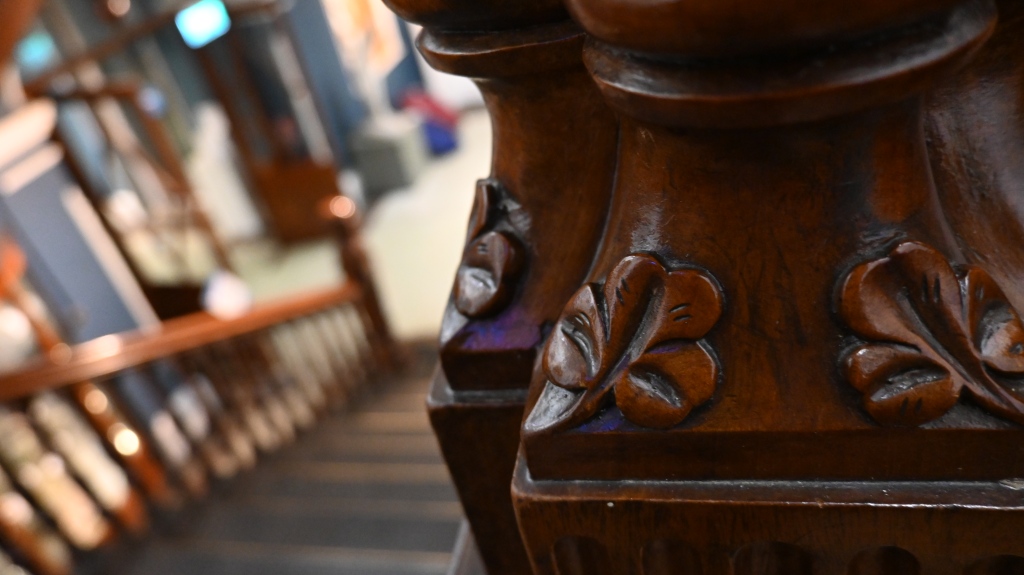
There has been a market on the present site since 1788 when it was opened as a meat shambles and known as “new markets”.
Today’s group of buildings were constructed in the mid-19th century with the ornamental entrance at Princes Street being constructed in 1862. The market changed little over the next century or so until it was seriously damaged by fire in 1980 and had to be extensively refurbished by Cork City Council.
On a rainy day it was a great place to explore. This was a place with fresh, local produce with traditional Cork foods as well as an array of international delights. (I spotted packets of Australian Tim Tams).
The stallholders are local and independent food producers or retailers, often with generations of families working in the market.
Feeling peckish, Fran and I made our way upstairs for my early lunch. Fran had the seafood chowder (which she described as excellent) and I had the soup (again excellent).
Fortified, Fran and I braved the gathering storm outside and followed the senior citizens’ second recommendation, The Crawford Art Gallery.
Crawford Art Gallery is a National Cultural Institution, dedicated to the visual arts, both historic and contemporary.
The collection comprises over 3,000 works, ranging from eighteenth-century Irish and European painting and sculpture, through to contemporary video installations. At the heart of the collection is a collection of Greek and Roman sculpture casts, brought to Cork in 1818 from the Vatican Museum in Rome.
I wasn’t sure what to expect to find, but I was impressed.
Disclaimer: I am not a fan of fine art. I like my art to evoke emotion within in. I’m a sort of Impressionist onwards kind of art lover. A lot of art leaves my cold – which is why I will usually be found in a city’s modern art gallery.
There’s a quote from Mexican poet Cesar A. Cruz: “Art should comfort the disturbed and disturb the comfortable. As a person with an admittedly at one stage “disturbed mind” – I find some modern art rubbish. As Andy Warhol said: “Modern Art is anything you can get away with”.
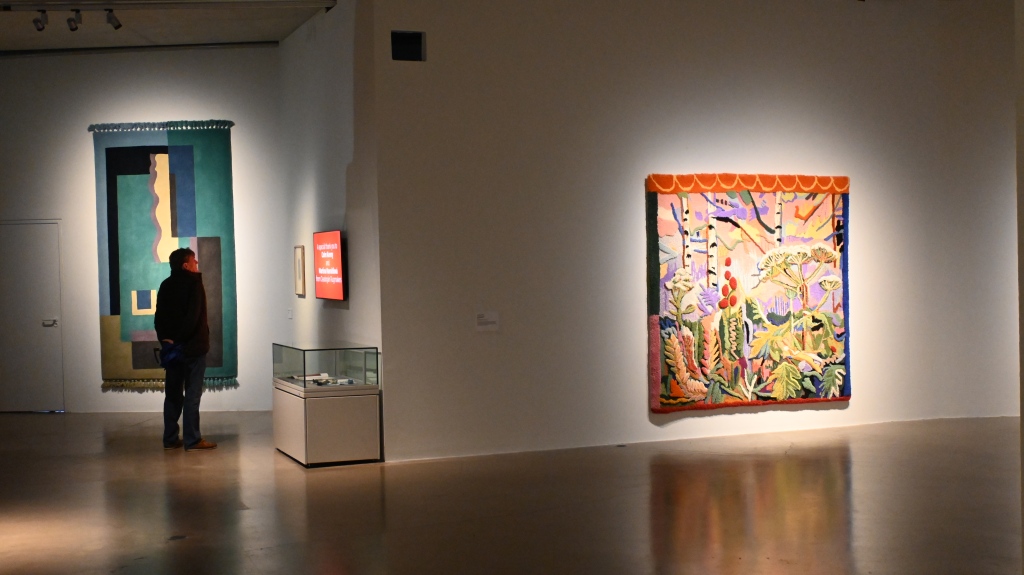
Strolling through the Crawford Art Gallery I have to being impressed. The art was wonderfully confronting at times, shockingly cute at other times, powerfully present at others, intrinsically interesting, caustically cruel … and an utter delight to behold.
I was particularly drawn to the artwork Northern Ireland artist Rita Duffy and her depiction of USA under former president Donald Trump. Her large scale explore planetary crisis and political chaos. Also impressive is her intense series of small, satirical drawings, The Emperor has No Clothes (2020).
We explored the art gallery for most of the morning, then stepped out into the howling gale that was Storm Babette. We got a bus back to the Park and Ride park and drove through increasing flood level back to our Cobh hideaway.
Our morning in Cork had whetted our appetite for the city. Next time, I promised myself, we would give the city a fair shake of the sauce bottle.


Where Art and Ideas meet across the centuries…
Crawford Art Gallery is a national cultural institution located in a significant heritage building in the heart of Cork city dedicated to the visual arts, both historic and contemporary.
The gallery’s collection comprises of over 3,000 works, ranging from eighteenth-century Irish and European painting and sculpture, through to contemporary video installations.
Crawford Art Gallery’s historic building provides an oasis of calm and tranquillity in the heart of Cork city.
The Gallery is home to a collection of national importance telling a compelling story of Cork and Ireland over the last three centuries.
Open 7 days a week the Gallery is free to enter and a must-see for locals and tourists alike. Crawford Art Gallery’s historic building provides an oasis of calm and tranquillity in the heart of Cork city, a monument to Cork’s ‘Golden Age’ and it recalls the ties between commercial success and the development of Cork city in the early eighteenth and nineteenth century.
Originally built in 1724 as the city’s custom house, the Gallery is home to the famous Canova Casts, gifted to the city of Cork two centuries ago. Well-known and loved works by 20th century Irish artists such as Seán Keating, Harry Clarke, Norah McGuinness, Mainie Jellett and Jack B. Yeats feature in the gallery’s historic collection, while the modern collection features work by contemporary artists such as Eilis O’Connell, Gerard Byrne, Dorothy Cross, Maud Cotter and Hughie O’Donoghue.
Cork city’s most visited cultural attraction, the Gallery boasts a stunning locally run café serving fresh local produce for which Cork is famous.
Where:
Emmett Place, Cork, Ireland
T12 TNE6
Tel: 021 480 5042
Visit Crawford Art Gallery
- The Gallery is free to enter and No booking is required
Opening Hours
N.B. Last entry is 15 minutes before closing
Monday–Saturday 10.00am–5.00pm*
Thursday until 8.00pm
Sundays and Bank Holidays
11.00 am–4.00pm
 on the road less travelled in Ireland and france
Leave a comment