A visit to a museum in County Clare provoked a strange reaction for music-loving Conal when he was confronted by Irish favourite, Ceili Music. It made him want to vomit.
By CONAL HEALY
Thursday, October 12, 2023 (2.30pm): This is a disclaimer: I dislike Irish Ceili Music. I also dislike bands that play Irish Ceili Music.
My father was a keen jazz/blues fan. My mother loved musicals. My old brother insisted (when I was a young teenager) that I listen to Jimi Hendrix, The Beatles, the Rolling Stones and Rory Gallagher.
By the time I turned 17, I was a purple-haired (briefly), safety-pin wearing punk rocker.
I love music. My spectrum runs for Gregorgian chanting to songstress Lizzo, and just about about everything inbetween. Apart from Irish Ceili Music (see links below).
For me, Irish Ceili Music was approved by the Catholic Church, Irish politicians (particularly from rural constituencies) lauded it.
It was poisonous (in my opinion) mixture of nationalism/heritage/fascism/ruralism/small mindedness/control/Gombeen* Irishness and God-awful beats.
It was the kind of music the parish priests believed that good Catholics should only listen to. And that wasn’t me.
It was the kind of music I wanted to escape from. It was torture to my ears.
(I should explain there is a difference between Irish Ceili Music and Irish Traditional Music. I love, for a large part, Irish Trad. And will happily sing many Irish Traditional songs, badly.)
You can imagine my reaction when I walked into The Burren Centre in Kilfenora, County Clare, and discovered there was a museum dedicated to Irish Ceili Music.
From nowhere my sneering 17-year-old Punk Rocker persona appeared. I shuddered as an audio-visual presentation kicked on. I wondered if this was a flashback to my youth, and anxiety attack, or just the overwhelming urge to vomit. Whatever I was feeling … it was not pleasant.
This was another world to me. This was music that millions of people loved. I was not one of them.
If I was generous, I would call Irish Ceili Music as a poor man’s Riverdance.
Here is what the Burren.ie website says: “The Kilfenora Ceili Band Parlour provides a unique opportunity to trace the music and history of the internationally renowned Kilfenora Ceili Band.
“With the help of top of the range visual displays, artefacts, musical instruments, artwork and acoustics the music of The Kilfenora Ceili Band will visually and aurally come to life before you.
“The exhibition is in an intimate setting and will take you on a rare musical treat of the music of the new and old band. If you plan on visiting the Burren region, this is a musical journey of discovery not to be missed, it has to be experienced!”.
Thanks, but no thanks.
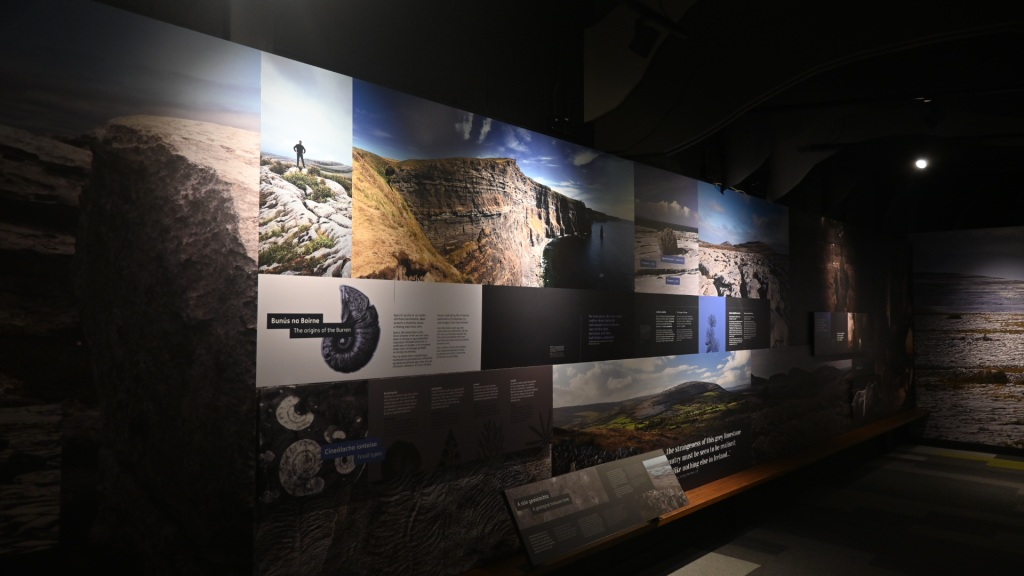
I skipped through the “parlour” and into the Burren Centre’s impressive “A Walk-Through Time” a multi-dimensional exhibition.
Beautifully displayed artefacts, original works of art, enthralling audio visual and interactive experiences together with dramatic life like reproductions of human activity all combine to provide an insight into the rich history of the Burren.
On show are extraordinary array of flora and wildlife, megalithic tombs and monuments older than Egypt’s pyramids.
A Walk-Through Time is a great introduction to The Burren. The display takes you through millions of years when this part of Ireland lay beneath a warm tropical sea.
“Follow the story of the formation of the Burren’s lunar landscape where man hunted bear, and wolves roamed the forests. See how, thousands of years ago, man left his mark on the landscape in the form of Dolmens and burial chambers. Like the world famous Poulnabrone Dolmen they still stand today, stone sentinels at the gates of our civilisation’s history,” says the Burren.ie website.
Visitor will discover how the limestone pavement was formed, and why Alpine, Artic and Mediterranean plants which require different climatic conditions grow side by side on the fertile rock.
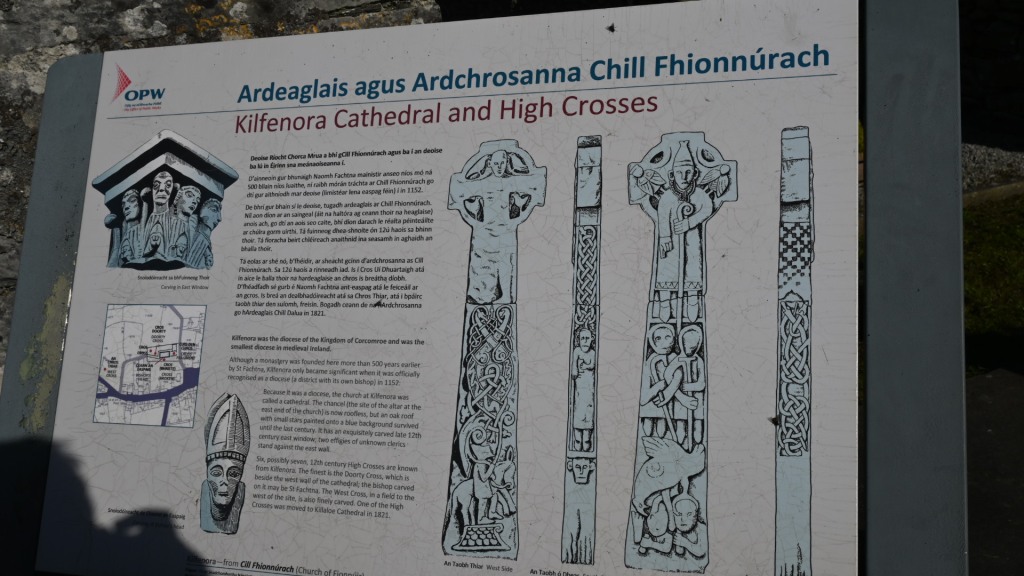
The Burren Centre is built beside the famed Kilfenora Cathedral (now a ruin). This cathedral was dedicated to St. Fachnan and built in about 1189 on the site of an early monastery.
Kilfenora, known as the city of the High Crosses, boasts one of the greatest concentrations of high crosses in Ireland, including the famed “Doorty Cross”.
Not only has this picturesque village its own medieval cathedral but can also claim the Pope as Bishop**.
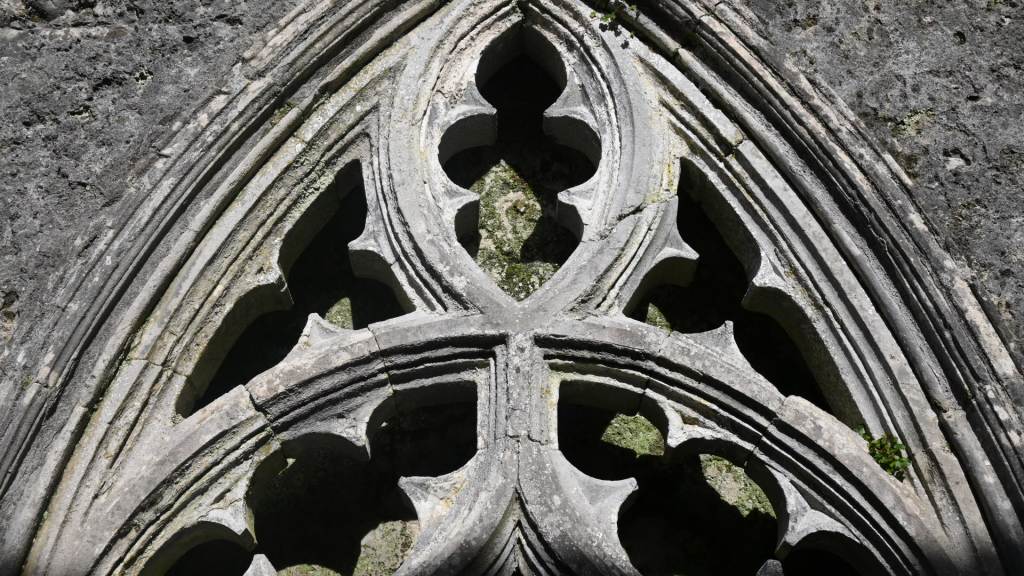
The cathedral is of architectural interest and contains some fine carvings, on grave slabs and on windows and doorways in the form of stone heads.
By way of explanation:
* “Gombeen” is now an adjective referring to all kinds of underhand or corrupt activities and to the mindset possessed by those engaged in such activities. In Irish politics, it is used to condemn an opponent for dishonesty or corruption, although its definition has become less precise with time and usage and it can also imply pettiness and close-mindedness.
Alternative modern parlance for a gombeen man is someone “on the make”. It is also used to describe certain Independent politicians who are seen to prioritize their constituents needs, no matter how trivial, over national interests. Source: Wikipedia
**The Pope is Bishop of Kilfenora: Pope Francis is also Bishop of Kilfenora in Co Clare, under a Papal Dictate that goes back as far as 1883.
The Bishop of Kilfenora was a separate episcopal title until 1750 when the Catholic church united it with Kilmacduagh, Co Galway and both dioceses were later united with the diocese of Galway.
This means there are three separate dioceses that are covered by the Bishop of Galway in both Connacht and Munster. However the rules of the church dictate that no bishop can be split between two different provinces. The rule was brought in to “prevent bishops from collecting dues from more than one province without doing the work”.
It is unlikely that this will ever change as canon law would have to be amended to allow for it and is now the “only one of these parishes that still exists”.
The Bishop of Kilfenora is not expected to make frequent visits to his parish as the Bishop of Galway handles all of the clerical and administrative duties.
Irish Ceili Music
 on the road less travelled in Ireland and france
Leave a comment