Leaving Dublin behind, Fran and Conal are returning to a part of Ireland they both love – the Wild Atlantic Way. Regarded as one of the world’s best coastal drives, Fran and Conal are back to fill in the gap from their last trip to Ireland and to visit County Clare – it’s an other world out there.
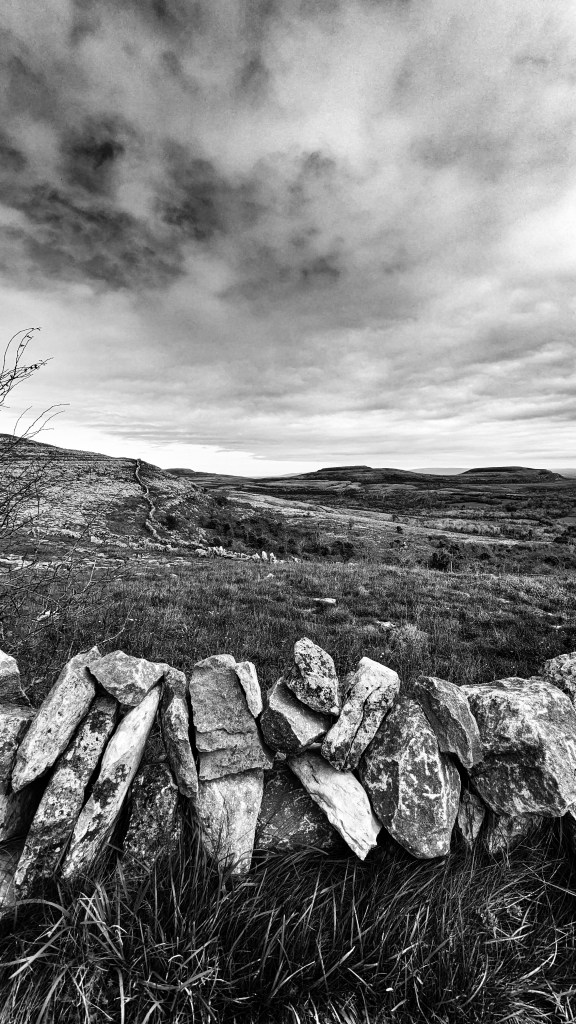
Wednesday, October 11, 2023: Ireland’s Wild Atlantic Way is on the outer edge of Europe and stretches along the west coast. It begins County Donegal and goes through the counties Leitrim, Sligo, Mayo, Galway, Clare, Limerick and Kerry, finishing in Kinsale, County Cork. The route is over 2600 km long.
On our last trip to Ireland (in 2019) Fran and I had driven most of the Way. We started in Donegal, stopped at Sligo, Achill Island, Galway and Kerry.
It had been an amazing experience, we had bypassed a section of the Way – County Clare. This was a chance to see The Cliffs of Moher and The Burren.
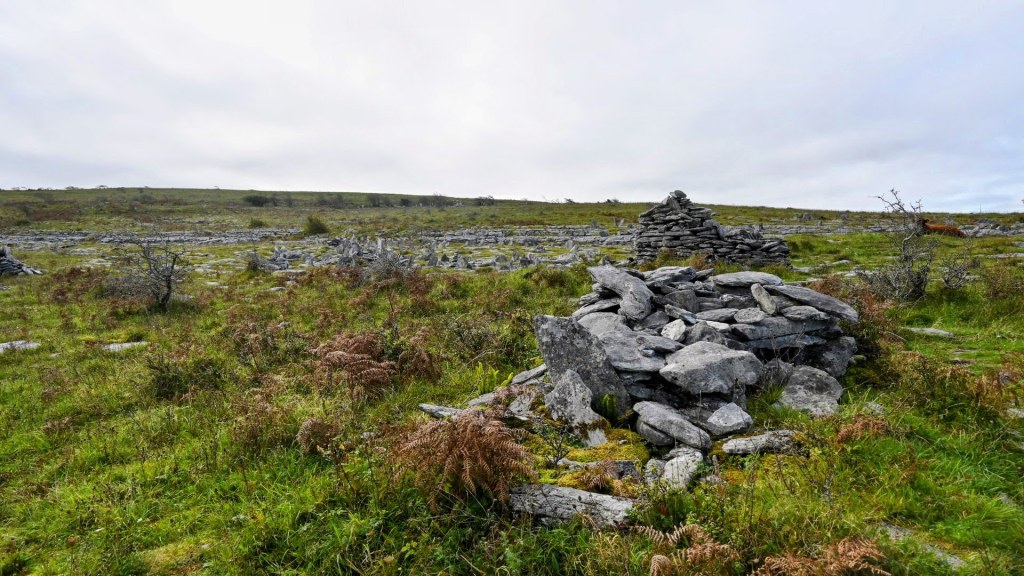
According to the Wild Atlantic Way website, visiting The Burren will make you wonder “if you have been beamed on to another planet. The reason being the landscape – this fascinating karst landscape. The rolling hills of the Burren are composed of limestone pavements. The translation of the Irish name An Bhoireann means Great Rock and this hits the nail on the head in this unusual region.”
The Burren is internationally famous for its rocky landscape, unusual combination of flora, thousands of archaeological sites and unique farming traditions. Because of these unusual features, most of the Burren is designated by the European Union as a Special Area of Conservation.
Oliver Cromwell’s lieutenant-general of horse and second-in-command in Ireland, Edmund Ludlow described (in the 17th century) the Burren as “a country where there is not enough water to drown a man, wood enough to hang one, nor earth enough to bury him.”
Much of its rock forms were established as sediments in a tropical sea some 350 million years ago, and its strata show generous signs of fossil, coral, crinoids, sea urchin, and ammonites. But the Burren, as we see it today, is actually relatively young in geological terms, having been scraped clean of all topsoil in the last Ice Age, just 10,000 years ago.
The world renowned Cliffs of Moher are over eight km long and tower imposingly over the Atlantic Ocean at the highest point with 214 metres.
This was to be our destination for the next few days.
As soon as we cleared Dublin, the rain clouds started to break up as we drove across the flatlands of Central Ireland.
Driving across Ireland is quite easy. You could have breakfast in Dublin on the east coast and then have morning tea in Galway, on the west coast.
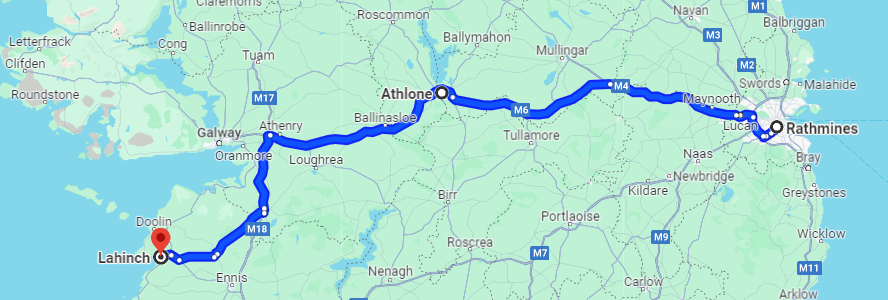
(When I was growing up my parent would pack the family car and my father would drive from Dublin to Achill Island, County Mayo, for our annual summer holiday. It was 303km, door-to-door. Today, the trip can be made in a little over four hours. As a child, the same trip took my father a minimum of six hours to drive. Two adults, four children in a fully-loaded car for six hours, can you imagine it? Could it be torture?)
“It’s a bit like driving from Sydney to Perth” explained Fran to the kids back in Australia as we coasted through the rolling fields of the Irish Midlands in the hire car.
We were going a bit beyond to Galway, to the town of Lahinch. As one of Western Europe’s leading surf centres, Lahinch attracts people from around the world to its many surf schools every year.
Being October, I doubt there would be many surfers getting their heads wet in the Atlantic Ocean off Lahinch.
What others say…
According to Ottsworld Travel blog: Ireland’s Wild Atlantic Way takes on the status of one of the longest coastal drives in the world at 1,600 miles. It joins the ranks of other great coastal roads like Nova Scotia’s Cabot Trail, Big Sur, Maui’s Kaekili Highway, and South Africa’s Garden Route.
Drive down narrow one-lane roads to see secret beaches, towering cliffs, ancient stone architecture, and more. This drive really does have it all; views, culture, and of course beer.
The whole time I was driving along the Wild Atlantic Way, I thought about the admiration I had for the Ireland Tourism Organization. Not many tourism offices would decide to take the smallest, single-lane, dangerous roads in the country and market them out to the world to come and drive on them! But thank goodness they did, as that’s what really sets it apart from other coastal drives I’ve done. It offers true driving thrills.
 on the road less travelled in Ireland and france
Leave a comment