The now-King Charles III stopped Fran and Conal from visiting the Third Best Garden in the World in County Wicklow in 2019. This time they were determined to tour the Must See sight located just outside Dublin.
By Conal Healy
Tuesday, October 10, 2023 (Second Breakfast): Today is our first full day in Dublin. Fran and I hop in the hire car and drive out to Enniskerry, County Wicklow, to have second breakfast at Poppies Restaurant.
The last time we were in Enniskerry was April 2019. We were on our way to visit the gardens at Powerscourt. Back then we drove up to the gates, only to be turned away by the Irish police. The grounds were shut.
Why? Prince Charles and Consort Camila were staying there.
We left disgruntled. Why? So what if they are members of the English Royal family … we’ve come half way around the world to see this garden!
Now in 2023, we were back. After breakfast we drove up to Powerscourt Garden and sailed through the gates.
Named Third Best Garden in the World by National Geographic, their website urged us to “lose yourself in 47 acres of carefully curated and maintained gardens. With so many wondrous features to explore and the stunning Powerscourt House listed as one of the top 10 globally (Lonely Planet), there is something to take everyone’s breath away.”
We parked and first explored the garden centre/gift shop. It was early October but already they were gearing up for Halloween and Christmas. I spotted a cute Rustic Hedgehog House – not something that might not be sold in Australia, there are no hedgehogs Down Under.
We wandered up to Powerscourt House, I kicked up autumn leaves as we went.
BACK IN TIME
Powerscourt Estate and the nearby Waterfall have been part of my life for decades. At least once a year, usually in summer the family would be packed into a car and taken usually to the Waterfall for a picnic.
Going to Ireland – no matter the time of year – meant a visit to Powerscourt. When my two children were younger they loved running and exploring the gardens. The last few times (when I have travelled solo) I drop into the cafe in the Powerscourt House for morning tea.
During the Covid-19 lockdowns, the adjoining golf course was still open to people who socially-distanced.
As an early-riser many time I had driven the scenic road south from Dublin to Enniskerrry and taken atmosphetic photos of the Wicklow mountains on the approach to Powerscourt House.
This time I would be showing Fran something from my childhood. Maybe seeing it through fresh eyes.
IN THE GARDEN
We paid our admission fee, didn’t feel the need to visit the coffee shop and set off to explore the gardens. Fran marveled at the flowers, I took photos. (At one point I was “given out to” by a gardener because I stepped off the path and put a foot on a bare piece of garden bed, I could have trampled something underfoot I was scolded.)
Took a photo of a plant called Pooh, remarked to Fran that it was a little bit shit.
(Dahlia ‘Pooh’ is a delightful dahlia variety, offering a unique blend of playful colors, approachable size, and straightforward growth. Its adaptability and charming appearance make it a highly sought-after choice for gardeners and floral designers. (Source: Gardenia.net.)
The light was flat thanks to the overcast skies so the flowers were lacking “pop”.
We wandered on. Passed a tree that had been planted by Mrs Bob Hawke, the market their visit to Ireland in 1987. Somebody at some point had added Ex- to the Mrs Bob Hawke on the plaque, following the divorce of the couple.
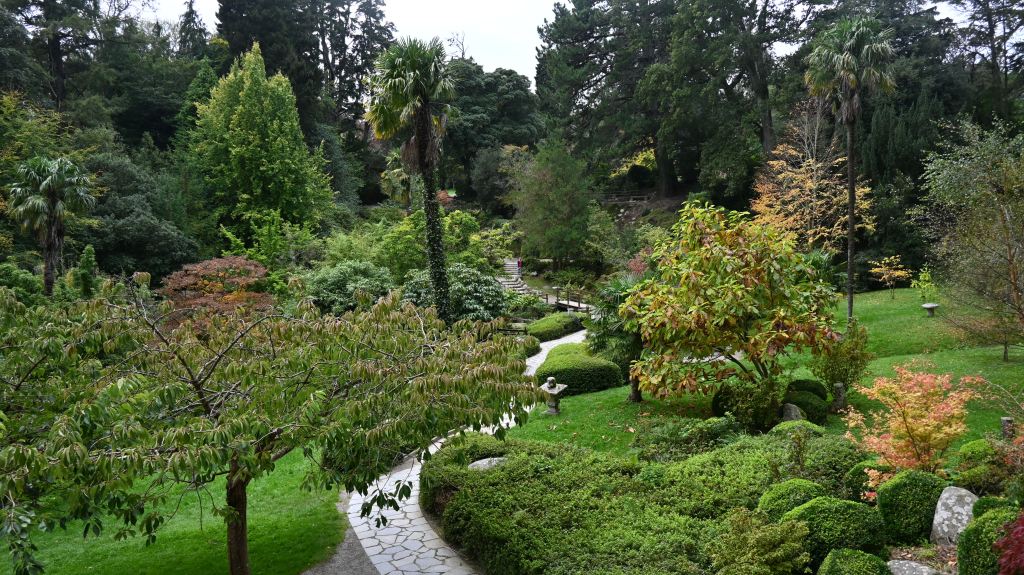
We followed the path past evergreens trees – natives, and exotics – and the deciduous slowly changing colour.
Fran stopped to enjoy the pet cemetery that dated back to Victorian times. The cemetery is believed to be the largest pets’ cemetery in any private Irish garden.
According to the website: “Children will love reading the names and learning about the animals buried in the cemetery, some over half a century ago. The families had a wide variety of pets including children’s ponies, ‘Tommy’ and his wife ‘Magic’ as well as ‘Swift’ and ‘Bully.’ Another favourite pet included ‘Eugenie’ the Jersey cow who had 17 calves and produced over 100,000 gallons of milk! The names of the pets are a joy to read, such as ‘Mrs Mare’, ‘Little Bots’ and ‘Doodles Chow’.”
One of the highlights is the Japanese Garden. According to the Powerscourt House website: “The Japanese Garden looks wonderful in spring when the azaleas are in full bloom and their blossoms perfume the air, and in autumn with the vibrant colours of the Japanese maples. Stone lanterns will guide you through the winding paths of the garden, bringing you to its innermost circle.
“Here you will find a Pagoda and a trickling stream under oriental Japanese bridges. The next circle is marked by a ring of Chinese Fortune Palms, which have been cultivated in China and Japan for thousands of years and were first brought to Europe in 1830.
“The upper circle provides stunning views of the Japanese Garden and the Sugar Loaf Mountain in the distance.”
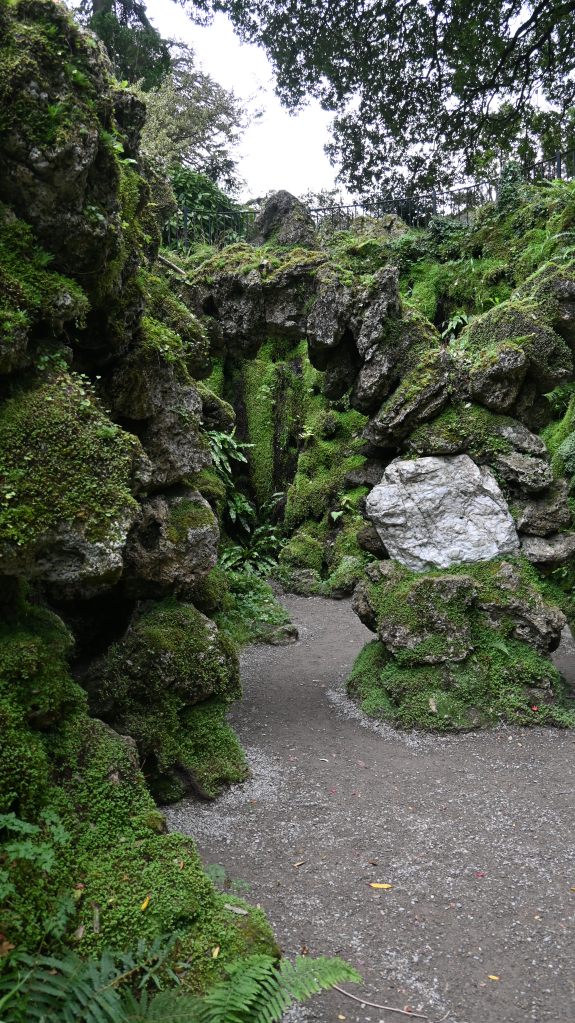
Next stop was an elaborate grotto and is one of the oldest features of Powerscourt gardens, dating from the 1st Viscount’s garden in 1740. According to the website, the grotto has “An air of 18th century romance still pervades here, with its secret pathways and idyllic atmosphere.
“The grotto is made from fossilised sphagnum moss, taken from the banks of the nearby river Dargle. The sounds of water trickling down the grotto’s moss-covered walls really adds to the enchanting and magical feel of the place.”
I got Fran to pose for photos here.
We strolled on to the: “Tower Valley surrounded by stunning variety of trees. Here you will find the Pepperpot Tower which was modelled on a pepper pot from Lord Powerscourt’s dining table!
“It is from this that Tower Valley received its distinctive name. Did you know that scenes from the award-winning TV series, The Tudors was filmed at the Pepperpot Tower?”
STAR QUALITY
We climbed the tower’s winding steps and enjoyed “the views of Powerscourt House and Gardens and get the perfect photo opportunity beside the many cannons surrounding the tower. Enjoy the wide variety of trees at Tower Valley including the Sitka Spruce, Western Red Cedar, European Silver Fir, Dawn Redwood, Torrey Pine and the Giant Sequoia.”
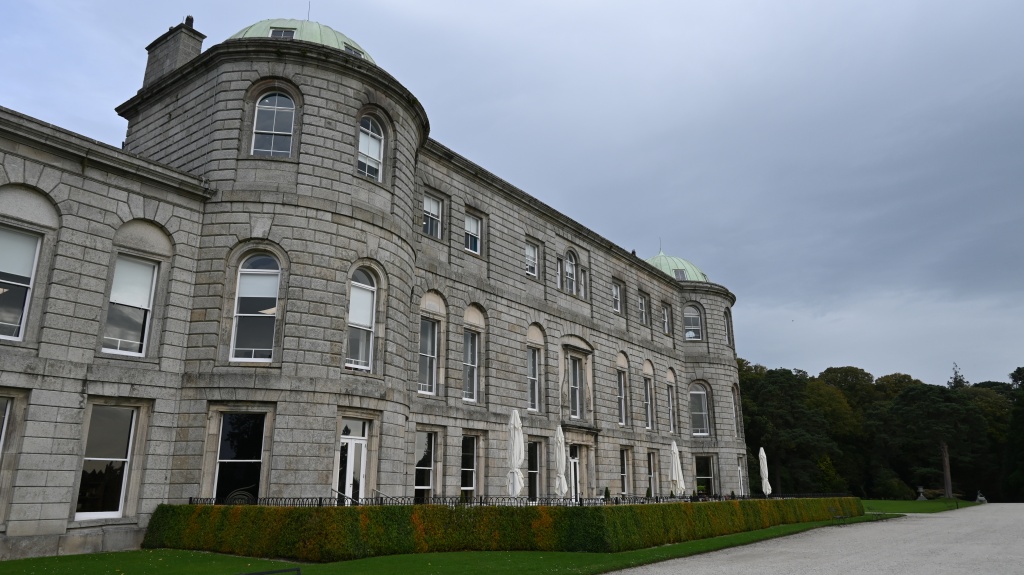
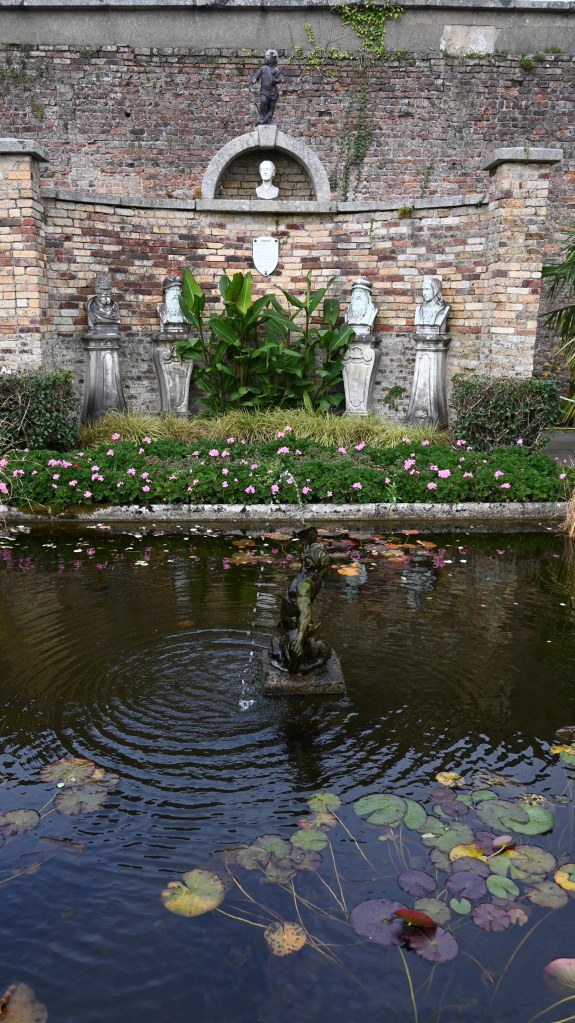
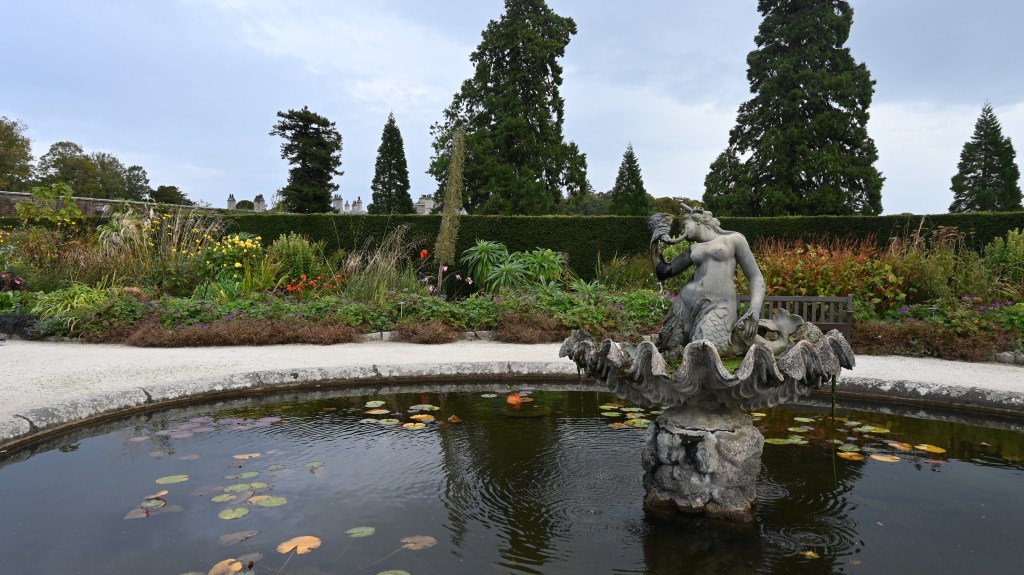
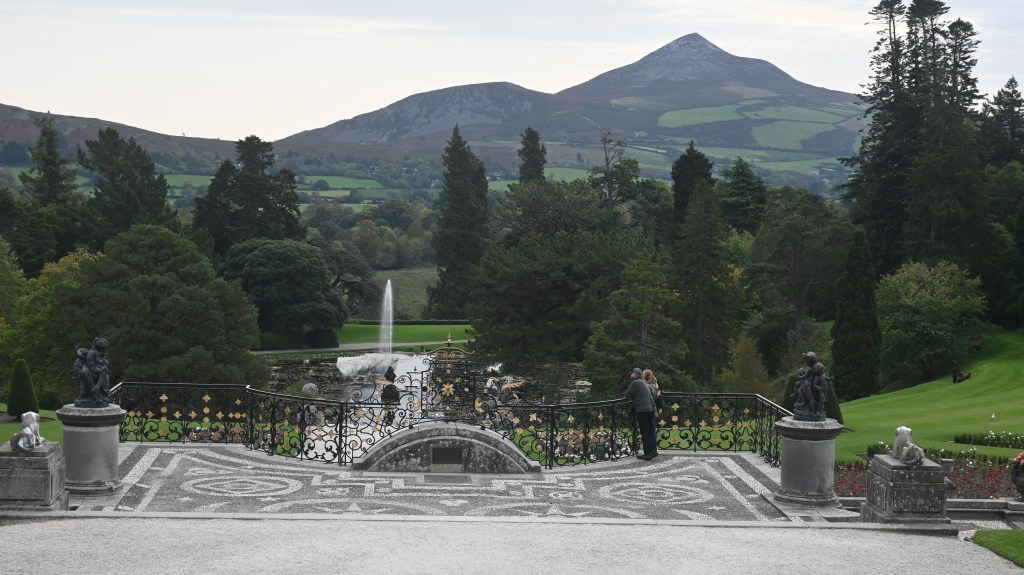
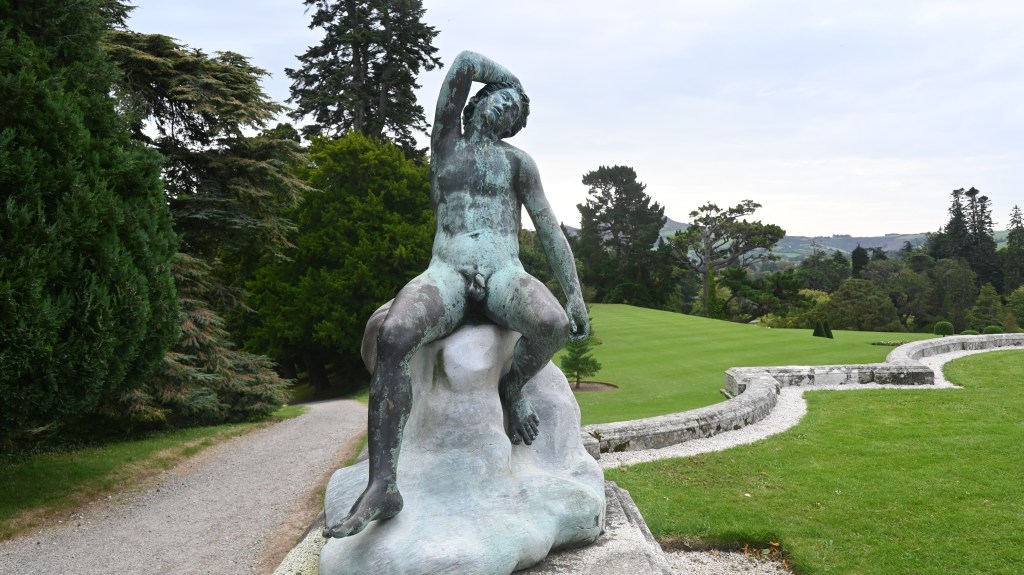
There was a final parade of the front of the house – admiring the statues (and giving them inappropriate titles), before doing a quick run through of the house (still being renovated), watched an interesting video/audio visual display of the history of the house … and left.
Powerscourt House and Gardens are well worth a visit. The gardens are magnificent, especially on a sunny day. Will be returning there.

ENTRY:
Adult – €9.00
Senior – €8.00
Student – €7.50
Child (U16) – €4.00
Child (U5) – Free
Family – €20.00







Open 7 Days a week, 363 days a year (excluding December 25th – 26th). The gardens close at Dusk in Winter (last entry 30 minutes before close).
Jan 09.30 – 16.30
Feb 09.30 – 17.00
Mar – Oct 09.30 – 17.30
Nov 09.30 – 17.00
Dec 09.30 – 16.30
A POTTED HISTORY
Powerscourt Estate is a large country estate which is noted for its house and landscaped gardens, today occupying 19 hectares (47 acres). The house, originally a 13th-century castle, was extensively altered during the 18th century by German architect Richard Cassels, starting in 1731 and finishing in 1741. A fire in 1974 left the house lying as a shell until it was renovated in 1996.
The Wingfield family had long coveted the lands of Phelim O’Toole of Powerscourt (d. 1603), seeking to draw Phelim O’Toole into an act of rebellion, the penalty for which was forfeiture.
The feud climaxed on 14 May 1603 when the Wingfields murdered Phelim in the place known as the Killing Hollow near Powerscourt, despite the fact that Phelim’s grandson and heir Turlough son of Phelim’s son (d. 1616) remained in occupation of Powerscourt.
King James I of England (d. 1625) on 27 October 1603 granted a lease of the manor of Powerscourt for 21 years to Sir Richard Wingfield for a rent of £6 Irish and a knight’s fee.
The reasons for the forfeiture of the O’Toole estates were because of the rebellious acts of Brian O’Neill (d. 1549) and Phelim O’Toole himself.
That the actions of O’Brien, O’Neill and O’Toole, Lord of Kinelarty, were cited as a reason for forfeiture was bizarre given the fact that at least Phelim O’Toole received a posthumous pardon for unspecified offences on 23 April 1549.
Furthermore, alongside Baron Cromwell his estates were surrendered to regrant.
The awarded family seat of the Viscounts Powerscourt, the estate has been owned by the Slazenger family, founders and former owners of the Slazenger sporting goods business, since 1961.
It is a popular tourist attraction, and includes Powerscourt Golf Club, an Avoca Handweavers restaurant, and an Autograph Collection Hotel.
Source: Wikipedia
 on the road less travelled in Ireland and france
Leave a comment