Photo: Conal Healy
By CONAL HEALY
It could have been lack of sleep. It could have been the stress of getting out of Paris that morning. It could have been the fact I was driving a different car. In France. On the “wrong” side of the road. In a strange city. With road signs (sometimes in French) that I was unfamiliar with. Whatever …
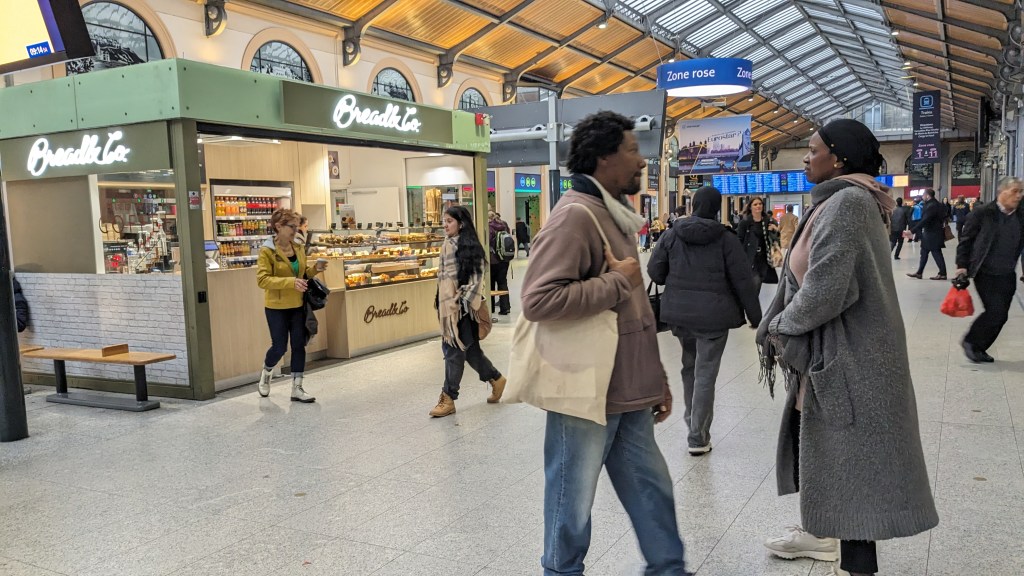
About 20 minutes earlier, Fran and I had picked up a hire car from the train station at Rouen.
Now, we were on a grassy knoll, beside a busy highway entry roundabout on-ramp and waiting for a tow-truck driver to arrive.
This day had really taken a turn for the worse.
***
The plan, formed 10-months earlier in Australia, was to take the road less travelled in France.
Fran and I went to Paris in 2019. Fran had fallen in love with the destination.
What lay beyond Paris, she mused. Could we go and find The Real France? Step off the tourist trail … and explore?
The best way, we decided, was by hire car. We would have to freedom of the open road.
We knew people who had collected their hire-car from central Paris (or at the airport) – they told of a nightmare exit from the French capital as they dealt with the French road system and the madness of city traffic.
Picking up a hire car outside Paris would, we figured, reduce some of the stress.
But where?
We wanted to visit Normandy and Brittany (in north-west France), so Rouen seemed a logical choice.
A 90-minute train journey north of Paris, Rouen was a good starting point for a trip with enough attractions in the city to warrant a stayover when we returned the car.
Three weeks on the open road in France – imagine what we could find!
I will be honest; I never expected a view of a roundabout in Rouen to be a trip highlight.


***
Travel plans are good. I love a good plan. Our plan to get from our Canal St Martin Airbnb (in the 10th arrondissement of Paris) to Rouen was simple.
An Uber ride from the apartment to Gare de Saint-Nazaire at 8am and then catch the 10.10am Normandy train to Rouen. (We would then pick up the hire car, drive three hours to St Malo and be there in time for a pleasant sunset over the sea. With a drink in hand?)
The plan started to unravel when Uber app got confused by the Irish/Europe SIM cards in our smart phones … and wouldn’t co-operate. Similar ridesharing apps got confused and baulked at sending us a car.
We hauled our luggage down to street level. Three empty taxis immediately flew past on the opposite side of the road …. before I could raise my arm to hail them.
It was raining. It was rush hour, in Paris. Fun, eh?
I wasn’t too worried, there was bound to be more taxis. We waited. And waited.
There wasn’t any more taxi coming, we decided.
Frustrated, we gathered our luggage and walked down to the nearby Gare de L’Est train station and got a taxi across Paris. In the rain, that morning it took 15 minutes to travel 150 metres, with the meter running. Oh well.
The previous night Fran had mastered the French train-booking application and got us tickets.
At Gare de Saint-Nazaire, we searched to find the right platform for the train to Rouen (we were an hour early). The train departure time was listed on the digital noticeboard – but there was no platform number.
Fran went looking for information, but nobody seemed to know anything.
It seemed to me that the railway company wanted to keep people guessing by NOT revealing the departing platform until just before the train was due to leave the station. I could be wrong about that.
As the clock ticked towards 10am, a small knot of would-be passengers joined us outside a particular “gate”. Earlier I had noticed how trains arriving from Rouen terminated at a particular platform, so Fran and I had wandered over to that gate.
A long train, with the name Normandie, suggested in my mind that we were standing at the right platform.
Moments after 10am, the station noticeboard clicked over to reveal the Rouen departure platform. We had guessed correctly. Everybody then surged forward onto the platform, eager to find a good seat.
Fran and I hauled all our luggage – two suitcases, four backpacks – into a second-class carriage and discovered there was only room for the two suitcases in the luggage racks. We grabbed four seats facing each other and spread ourselves out.
We had just settled in when an angry Frenchman stormed into the carriage and started berating us! I didn’t know what he was saying precisely …. But I gathered he didn’t like that we had paid for two seats but were actually occupying four.
Okay, we got the hint and moved to a two-seater and popped the backpacks at our feet, or on our laps.
Moment later, our once-prized four seater was grabbed by two French teenagers who sprawled out … like we had done. The once-angry French man said nothing.
It would have been nice to describe the scenery as the train travelled northwards. There might have been vineyards, rolling hills, picturesque villages? Really, there was nothing to see. Rain clouds had been anchored over northern France all week, so there was little to see from our train window.
We ate our breakfast of jambon et fromage baguette (ie ham and cheese rolls) and settled back and tried to relax.
As the train pulled into Rouen, Fran declared happily: “This is where our adventure begins”.
I didn’t realise it, but that comment almost sounded like foreshadowing.
***
At the Rouen train station we queued in the hire-car office to get our vehicle. The reservation had been made about 10 months earlier (on the other side of the planet in Australia). We had asked for a “small to medium-sized automatic vehicle”, we got a Suzuki Vitara.
The Suzuki website describes the car thus: “…stylish & sporty Vitara is a compact SUV that combines great performance, advanced safety technology & eye-catching design”. (After driving one for two weeks I would call it an underpowered piece of shit.)
In retrospect, we made a wise move by paying for complete insurance on the car. We didn’t know what lay ahead of us.
***
I have driven on the “other side of the road” before, that was in the USA. Back in 2006. My abiding memory of that family holiday were the kids telling me (repeatedly): “The OTHER SIDE of the ROAD, DAD!”
So, I knew what to expect.
Back to Rouen.
We got out of the Vitara out of the multi-storey car park without trouble. Fran keyed in our destination (in St Malo) and we set off with the Sat Nav giving us directions.
There were a few things I know NOW that I wish I had known BEFORE getting into the Vitara.
Firstly, it is wider (and taller) than my Australian car. Secondly, French roads are narrower than their Australian counterparts.
And thirdly, the French love their gutters – and they love them tall on one side, sharp-edged and made of hard concrete. Maybe even stone. Compared to their gently sloping Australian cousins, French gutters can be like mini-walls, or more like anti-tank obstacles from World War One/Two.
While I was concentrating on staying away from other road users, I didn’t realise that I was straying too close to these one-walled gutters.
Fran tried to warn me: “You are getting awfully close to those gutters” she told me with rising tension in her voice.
I was too busy staying clear of the traffic on the other side of the car.
Fran tried to warn me again, but with more force in her vice: “You’re too close to the gutters, Conal!”
So, what’s the problem, if I was in Australia and I hit a gutter I would go up onto a pavement … what’s the big deal?
I didn’t know about the French roadside anti-tank traps.
Then it happened.
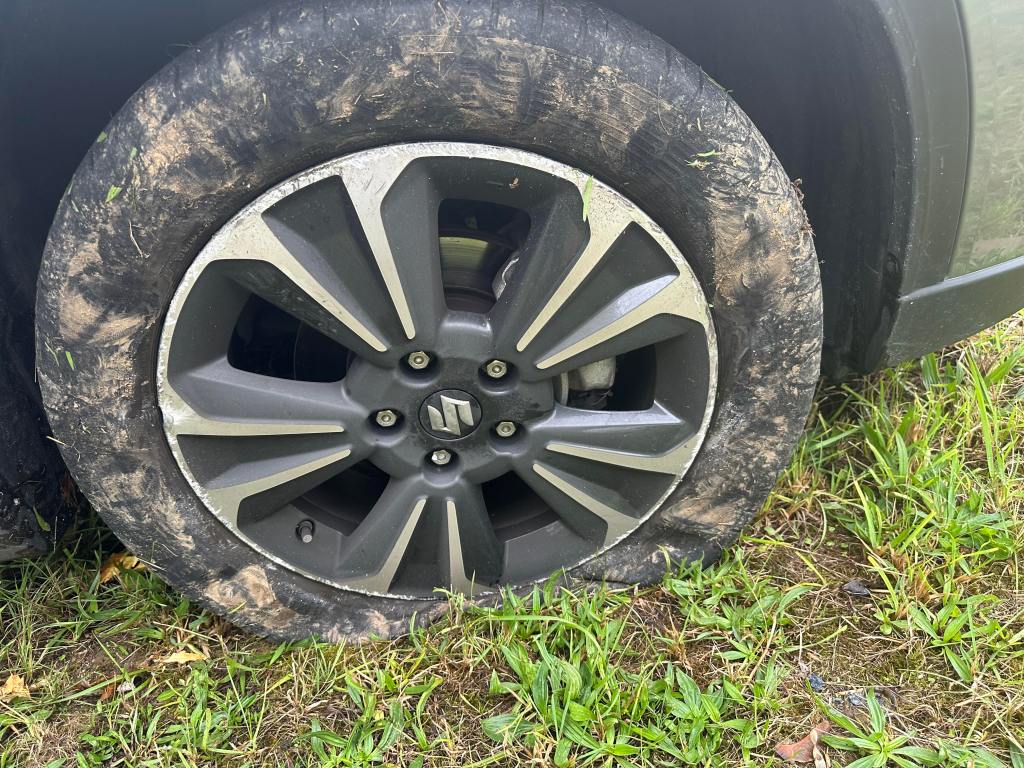
The two passenger-side tyres hit the walled-gutter and blew. On a busy four-lane road, at lunchtime, the warning signs on the dashboard lit up. The tyres were losing pressure, and fast. And there was nowhere to pull over.
The Vitara slumped to one side as it rode on the rims of the wheel, steering became sluggish. Luckily a grassy knoll appeared and I was able to nurse the car over the demon gutter, out of the traffic and onto the grass. We were safe. We had survived.
What do we do now?
***
If I had blown one tyre, I could have fixed that myself. There was bound to be a spare in the boot.
Two tyres? Not possible. We needed help.
Fran jumped into action. She called French roadside assistance and despite a few language difficulties (and precise location problems) managed to get us help. About 40 minutes later a French tow-truck operator arrived.
We got lucky with the operator – he understood and spoke English. He hauled the Vitara onto the truck and gave us a lift to the Rouen head office of the car hire firm. The tow truck operator explained to the staff (who didn’t speak Anglais) what had happened.
We had to fill out an accident report (and make a sketch of what happened) and – long story short – we were given another automatic Suzuki Vitara.
Three hours after blowing two tyres in the accident, I climbed anxiously into the new car for a long drive across northern France.
Tired, anxious, stressed and afraid, I drove while Fran navigated our safe exit out of the city of Rouen. What lay ahead of us?

***
Out on the highway, I made the Rookie Error of staying in the far left lane (the slow lane in Australia) before realizing I was actually in the Fast Lane in France … blocking traffic, and making other drivers very angry (to judge by the car horns). I slipped over to the far-right lane and stayed there until I re-gained my confidence. My first few hours of driving in France had not gone too well for me.
I stayed behind slow moving truck, happy to be travelling at 80/90km per hour in 120-130km zone.
If a truck turned off, we stayed in the slow lane – still 20km under the speed limit, trying not to get into get into another accident. More than one a day is bad for your health.
It was an almost straight run to St Malo. In the fading, evening light I could see the heavy traffic on the other side of the road. We passed a few nasty roadside accidents too and saw the white light of a hybrid car engine/battery on fire.
It was enough to make you drive extra carefully.
It took us four hours to make it to St Malo – we arrived tired, hungry and brain dead.
That day I learned that in France, the centre line was your friend and the gutter is a deadly enemy.
As Fran had said earlier that day, our adventure had begun.
***
In St Malo the next morning Fran and I discussed the events of the previous day.
The two tyres blowing in traffic had shaken both of us – the hire car was now a place that generated anxiety for us. Fran was now anxious about driving in France, this meant that I might have to do a lot of the driving if we continued.
Do we really want to do another three weeks of traffic torture?
Could we stay in St Malo for the rest of the holiday? Could we cut our losses and return the car?
Maybe go back to the safety of Paris, by train?
We left the Vitara alone and spent the day exploring St Malo … on foot.
***
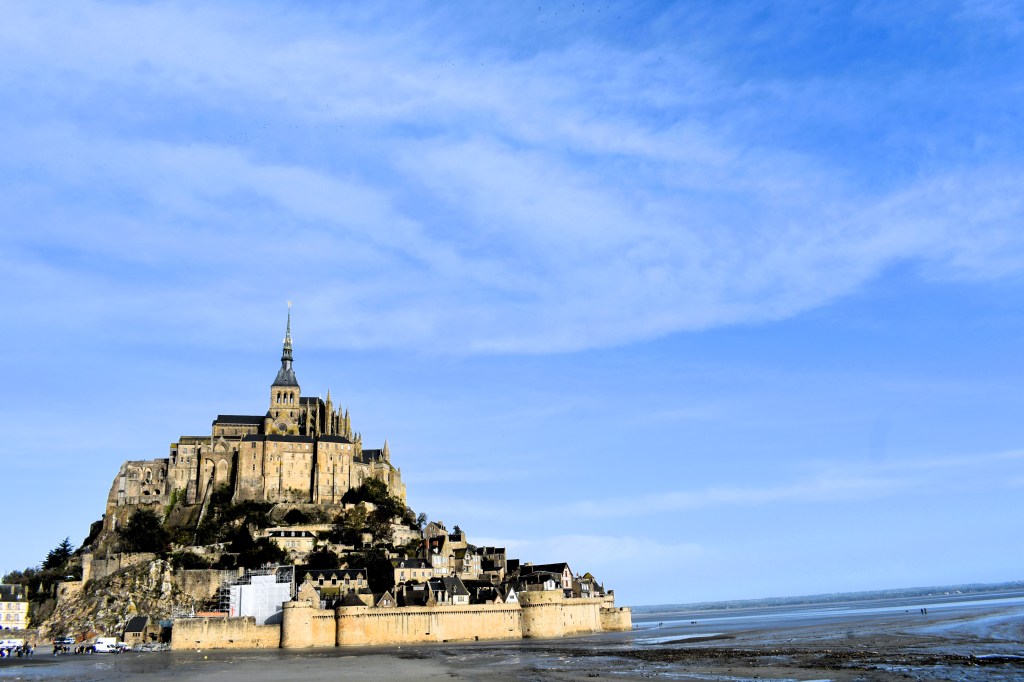
For decades I had wanted to visit Mont St Michel – a medieval island with a monastery in the sky off the coast of Normandy. It was about 50kms away from St Malo. If we wanted to see it we could book a private tour (cost $1000), … or get back into the hire car and drive there.
I decided to embrace my fear and do it anyway – it would be back in the car for the visit to the UNESCO World Heritage Site.
My return to the Car of Anxiety didn’t start well. At the traffic lights, at bottom of the street, I stopped for a red light and mistakenly moved into a space meant for bikes and scooters.
It shouldn’t have been a big deal, except at that particular moment a local council garbage truck driver decided to take the sharp turn into the street … and found me in the space needed to make the turn, but now couldn’t.
He was stuck. I was stuck.
I was now a metre away from the a very large garbage truck. And I froze.
The anxiety, stress and fear from the blown-tyre incident erupted in my body … I couldn’t think.
There was no way out. I didn’t panic, I froze.
The garbage truck driver wound down his window and started shouting in French at me. Obviously he was making helpful suggestions to me … which I failed to understand.
Then the driver of the car behind me hit his horn. I looked into the rear view mirror and saw him gesticulating at me. And he was angry.
In that moment, I pulled myself together. I realized there was a gap ahead, I just needed to reverse slightly and do a full lock of the steering wheel and squeeze past the truck.
I did that. The garbage truck eased past the Vitara, the angry man behind me overtook me, at speed.
The incident probably only lasted 90 seconds … but it added another layer of anxiety and stress to my feeling about the car.
Rattled, I drove on to Mont St Michel. How much more of this French driving could a cope with?
***
A few days later (after four days behind the wheel), I wrote in my travel diary: “I am not enjoying driving in French cities.
“I find it stressful. It makes me anxious. I feel I am putting Fran’s life at risk. I feel I am putting my own life at risk. And the lives of other people.
“It is frightening. I had dry-mouth anxiety, which is only reinforcing the anxiety I was feeling before getting into the car.
“Occasionally I find myself driving on the wrong side of the road, Fran has to remind me to move across.
“Getting out of the cities is hard work. I have to concentrate on driving while Fran navigates.
“I double-check every turn and every lane change … just to be sure it is safe. I don’t mind missing a turn, Google Maps will suggest a re-route, I worry about being side-swiped or being back ended, or blowing tyres if I hit a gutter.
“All of this is before I take into account other road hazards: pedestrians, bike riders, or people on motorized skateboards. (I was roundly abused by a French scooterist on a downhill road in Dinard a few days ago … for going too slow in a 30km zone).
“I feel comfortable and confident in my own car in Australia. Here in France, the underpowered Suzuki is a place of stress and anxiety. I feel I am in danger every time I step into it.
“As I drive more, it is becoming less stressful. For the first few days of driving the palms of my hands would turn bright pink, from holding the steering wheel too tightly.
“My anxiety stems – I believe – from blowing those two tyres on the first day. If that hadn’t happened … I think driving in France would have been easier.”
Driving in France was daunting. My time behind the wheel did become less stressful as I drove more (and as Fran shared the driving duties). I was comfortable driving at 130km/h. I was equally comfortable driving on the minor D-roads, despite an almost daily encounter with a slow-moving tractor (of an equally-slow truck transporting logs).
I learned to drive at 30km/h – which is the speed limit in most residential areas – as it gave me time to check for dangers, and work on reducing my anxiety.
The French have a fascination with roundabouts. In three weeks, we must have encountered hundreds of these road features. The single lane roundabouts were fine, it was the bigger two-lane roundabout you had to be careful with, especially if there was another car on the inside. Invariably both Fran and I would be busily looking for the correct exit: “That’s the one … just there”. And rejoiced that we were on the D737 to Troyes.
We had an interesting relationship with the car Sat Nav system. It got to the stage where we sometimes relied on our smartphone Google Maps for assistance. Sometimes even that failed us (we were in rural areas with bad internet service) and we resorted to our trusted road maps as well as following the French roadside signs to our next destination.
Getting lost in France meant we usually passed through small (usually deserted) French villages. If a place piqued our interest, we would stop to see if we could get a coffee and visit the local patisserie for a tasty treat before getting back in the main road.
There was no greater joy in the Car of Anxiety than when the Sat Nav announced: “Stay on this road for the next 90kms”. Fran and I would give a small cheer, congratulate ourselves, and relax (slightly) knowing we had escaped city driving and all the dangers that come with that.
Now for the joys of the open road, and maybe a sneaky side trip to a small French village? How about Montmorillon? Sound good, let’s go!
***

Other driving in France incidents:
Taking the wrong turn in a large French petrol station and coming face to face with a very large semi-articulated truck, I had to get off road immediately (onto a grassy area) and go cross-country to get back to the petrol bowser.
There was the time we missed the exit out of Nantes (the eight largest city in France) and It took us 20 minutes to retrace our steps.
Google Maps directing us down a flooded farm road in the Loire Valley.
The time we lost the hire car in one of the seven car parks at Mt St Michel.
Google Maps sending us down a road so narrow in Rouen that the driver side wing mirror was about centimeters away from the car parked on the driver’s side.
Loving that Breton farmer don’t fence the fields next to the road – if you go off the road (by accident) you are likely to end up in a field, rather than smashed into a fence/wall.
Google Maps telling us our destination lay at the end of a narrow alleyway in St Malo, that was lined with parked cars. Our destination was somewhere else.
The garage space that was so narrow in Troyes, passenger Fran had to get out of the car before we could drive in. And I had to suck in my belly, hold my breath, and slide out sideways to get out. (We ended up scraping the door handles on the side of the car getting out of that garage.)
Driving up a narrow one-way street (on our return to Rouen) and being faced with a line of cars coming towards us. We swerved into a space reserved for a garage door exit and allowed the cars to go past. It was impossible to reverse, impossible to do a three-point-turn (no matter how many times we tried). In the end Fran had to walk up the road, and alert me if there were any other cars coming.
Fran overcame her fears of driving in France on our sixth day on the road. We shared the driving from that point. Each taking turns to drive, while the other person navigated. In the course of three weeks we clocked up about 2050kms on French roads.
Footnote: The word “Gutter” became an integral part of Fran and I’s holiday vocabulary after the accident in Rouen. As we drove across France, any time Fran believed I was getting too close to the edge of the road she would simply say “Gutter”, and I would drift back towards the centre of the road. There was rarely a day in three weeks of driving when the word “Gutter” wasn’t used.
 on the road less travelled in Ireland and france
Leave a comment