
By Conal Healy
One of the good things about Paris in late April are the long days. The days seem to go on forever, for over 14 hours in fact. One of the bad things about Paris in late April are the long days, especially if you have booked a nighttime guided stroll through the streets of the French capital and were hoping to see historic building illuminated.
Fran and I were sitting in a small park on the banks of the Seine waiting for Stroll Host to show.
Our mobile phones had lost power hours before. I knew were to go, how to get there but we had no way of making contact with the street talker. The sun was setting, the little heat from the day was slipping away and a chill was descending.
I, for one, was hoping the stroll through Paris would be cancelled and we could head back to our Airbnb in Canal St Martin. It had been a long day of sightseeing and we’d already walked over 10kms. Beers and bed were looking very attractive.
We had booked the tour tickets months earlier (from Australia) and it seemed like a good idea. Especially as the evening guided tour started with a bottle of wine. Now, the idea of (more) walking in Paris was quickly losing it’s appeal.
A few hours earlier we had been up in Montremartre, waiting for a hop-on/hop-off bus. We waited but the evening rush hour traffic had slowed everything to a crawl – especially in this part of Paris. The only commuters making progress seemed to be on bikes or scooters.
Our destination was a metro station, Cite, close to Notre Dame and we had to be there by 8pm. It was now 6.30pm. We reviewed our situation, gave up on the return of the bus and dived into the crush of people heading for home.
It wasn’t going to be a straight Metro run – there were a few line changes – but by this stage we were old hands at this mass transport system (this was our third day in Paris).
We emerged in plenty of time beside the Seine and set off to find the meeting spot. “Behind the statue of Henry V” said the email … and then the phone battery spluttered and expired. So were we to meet behind the statue? Or in the park behind the statue?
We had been rummaging around our backpack, looking for emergency food and or lollies … anything that would keep the hunger pangs at bay.
Fran and I moved down to the park, which had the Seine on both sides. Already the seats and best spots were filling with people carrying beers, wines and the occasional picnic.

It was a Tuesday evening, the sunset promised to be magnificent and it seemed a lot of young – and not so young – people were planning to have a few “sundowners” with friends.
To me it sounded like a few good idea: Head back to Canal St Martin, stop at the Franprix shop and watch the sunset over canal and eat cheese and crackers, a hot shower and bed. Oh to be horizontal in bed.
It was not to be. Our tour host, James, turned up and the rest of the party arrived. Tonight there would be five us.
Introductions were made, a bottle of wine (“from a nice vineyard here the Pyrenees”) and James started telling us stories about the foundation of Paris. The Romans recorded meeting a tribe called the “Lutetians” who saw the legions coming, burnt everything and disappeared from history.
We were told the park – where were standing – was originally used to display executed bodies. (As we listened to James, the evening air was filled with dope smoke as many people decided to kick back and watch a blood-red sun sink into the waters of the Seine.)
James promised us the history of Paris (2000 years in 2 hours) and he delivered, in English and in Spanish (there were a couple from Columbia on the tour). We walked, talked and chatted.
We saw the house (now abandoned) where Picasso painted his masterpiece Guernica, across the road is a (now expensive) restaurant where XIII was crowned King of France. And dozens of other places besides.
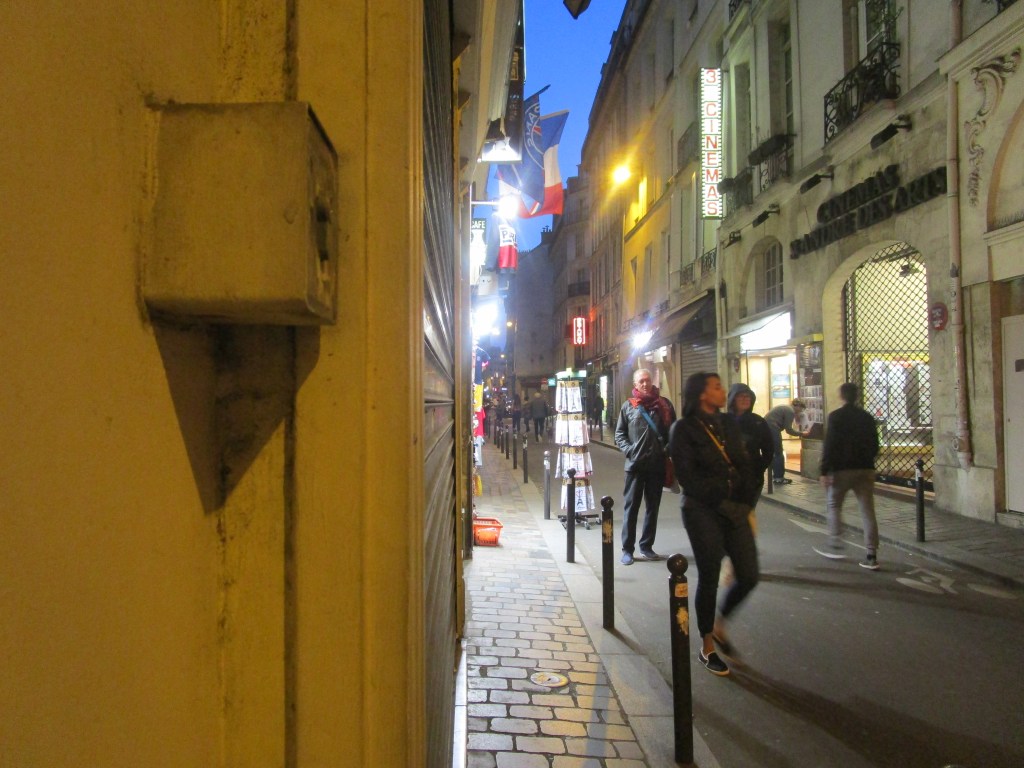
We wandered the back streets of Left Bank, people wandering away from the tour to grab take away food from small, street stall. Fran and I kept walking. It was nearly 10pm when we got to the spot which could have been the high point of the evening – seeing the Notre Dame cathedral illuminated at night.
We stood on the bridge, the cold night air sinking into our bones, and peered into the darkness behind James. All that we could see was inky blackness. It was impossible to see the cathedral.
Notre Dame has an interesting history. The cathedral’s construction was begun in 1160 under Bishop Maurice de Sully and was largely complete by 1260, though it was modified frequently in the following centuries. There were no architect drawing for the building (“You’ll notice how the towers are a different width” said James.)
In the 1790s, Notre-Dame suffered desecration during the French Revolution; much of its religious imagery was damaged or destroyed. In the 19th century, the cathedral was used for the coronation of Napoleon I.
However there were calls in the early 19th Century for the building to be demolished.
Popular interest in the cathedral came to the fore in 1831 with the publication Victor Hugo’s novel The Hunchback of Notre-Dame. This led to a major restoration project between 1844 and 1864.
The cathedral is one of the most widely recognized symbols of the city of Paris and the French nation. Approximately 12 million people visited Notre-Dame annually, making it the most visited monument in Paris (before 2019).
The fire in the wooden roof of the cathedral a few weeks earlier had shut the cathedral to the public. On that cold April night we discussed how quickly the rich of France had promised money for the rebuilding of the cathedral at a time when workers were rioting in the street for wage rises. We walked on, into the night.
We took our leave at the Cite station and rode the Metro back to Gare de L’Est. Still starving, the only place open was a Burger King. We ordered some fast food and devoured it.
That was our last dinner in Paris. We got back to Aibnb and fell into bed.

 on the road less travelled in Ireland and france
Leave a comment